

Quick summary
Accolade is the best alternative to Planisware for enterprise innovation management, earning an overall score of 4.3 out of 5 in our evaluation compared to Planisware’s 3.2. We graded six leading platforms on a 70-point rubric spanning seven innovation competencies. Accolade outperforms Planisware with its innovation-first focus, self-service hyperconfigurability, and built-in support for front-end activities like idea campaigns and tech scouting. Planview is the other major SPM/PPM option, with stronger idea management, reporting, and decision-making ease of use. Itonics, Hype Innovation, and Qmarkets outscore Planisware in FEI but trail it in every other competency, making them point solutions for ideation and tech scouting rather than portfolio management platforms.
Would you like your eggs soft-boiled, hard-boiled, poached, over easy, basted, scrambled, or sunny side up? Bacon or sausage? Hash browns or country potatoes? White bread, sourdough, wheat, or English muffin? Now, how about your innovation management software, hon? We live in an age of hyperconfigurability, and innovation managers have a smorgasbord of options when it comes to their tools.
Planisware is one of the most well-known and most-used enterprise innovation management systems on the market. It’s a powerful tool that helps global organizations manage huge portfolios, keeping innovation projects, programs, and initiatives both on schedule and on strategy.
Enterprises use Planisware as both a strategic portfolio management (SPM) system and a project portfolio management (PPM) system. It’s bigger than a general project management tool: it tracks thousands of projects at a time, rolling information from all of an enterprise’s innovation activities into portfolio-level reports, financial forecasts, and roadmaps. And it’s far more innovation-specific than general enterprise tools like AirTable or Smartsheet, so it’s a more intuitive environment for managing Stage-Gate methodologies, innovation CapEx projects, and diverse resource capacity models.
But Planisware is not the only system that does this.
Planisware is one of the “big three” innovation management systems (along with Accolade and Planview). These tools handle innovation at the enterprise level, with all the governance policies, matrixed hierarchies, and resource demands that come with it. And of course, there are other, smaller systems that show up when you start searching for innovation management software.
If you’re considering Planisware — or if you’re considering switching from Planisware — you’re probably curious about the alternatives.
You’re in the right place.
The 5 Best Planisware Alternatives, Ranked
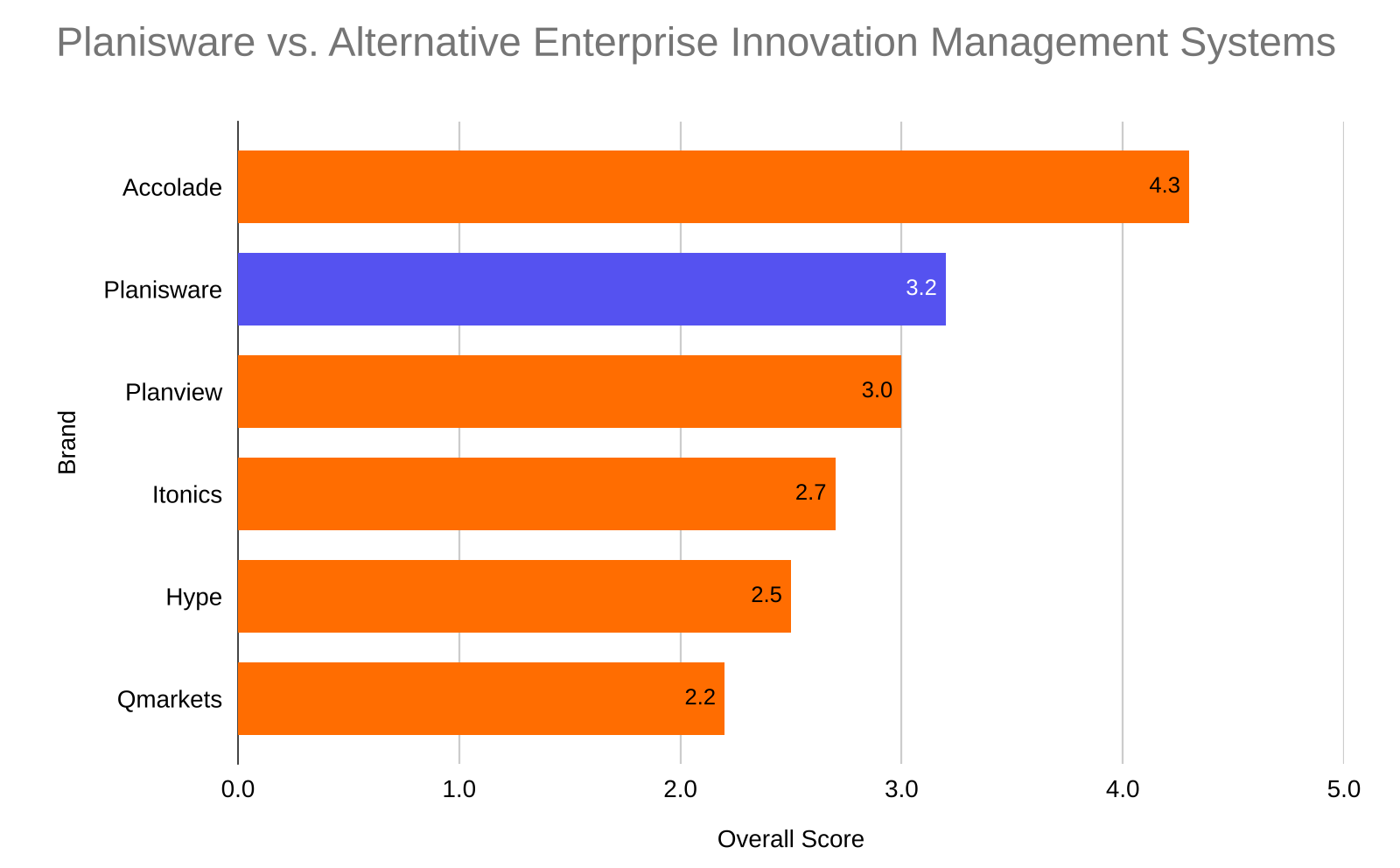
We’ll take a closer look at each of these soon, but here’s how the leading Planisware alternatives stack up on enterprise innovation management (scores are out of a perfect 5):
- Accolade: 4.3
- Planview: 3.0
- Itonics: 2.7
- Hype Innovation: 2.5
- Qmarkets: 2.2
We evaluated these contenders (along with Planisware) on their ability to enable seven key innovation competencies. This process graded systems on a 70-point rubric, resulting in a single final score for every player. If you’d like to know what those 70 points are, how they were grouped together, and the rationale behind this methodology, you can read all about it here.
The main things to keep in mind as you consider these alternatives:
Grades focus on growth outcomes. The north star for this scoring system was answering the question, “How well does this system enable growth innovation at the enterprise level?” We assume the ultimate outcome you want from your innovation efforts is growth: more revenue, wider margins, more market share, etc. Therefore, every capability was chosen and weighted with that end in mind.
Final scores are comprehensive. We looked at capabilities that span the entire innovation lifecycle, from strategic planning to project execution. This means systems built primarily for managing front-end innovation were still graded on portfolio orchestration capabilities. To give you a more complete picture, we’re including each vendor’s subscores.
We’re focusing on strengths relative to Planisware. This guide assumes you’re already familiar with Planisware’s strengths and focuses on the reasons people choose alternatives. If you want a fuller picture of the innovation management software landscape, explore our brand-agnostic ranking of all six systems, or check out our deep dive comparison of Planisware and Accolade.
All scores are assigned by Wellspring, the makers of Accolade. Our research included interviews with people who have used other systems, and we’ve tried to be generous and fair, but keep in mind that we’re operating with our own bias.
Now, let’s take a look at the tools you should consider alongside Planisware.
Accolade: A Better End-to-End, Bespoke Solution
Three key factors make Accolade the best alternative to Planisware: its focus on innovation, its configurability, and its comprehensiveness.
Planisware Is Portfolio-First; Accolade Is Innovation-First
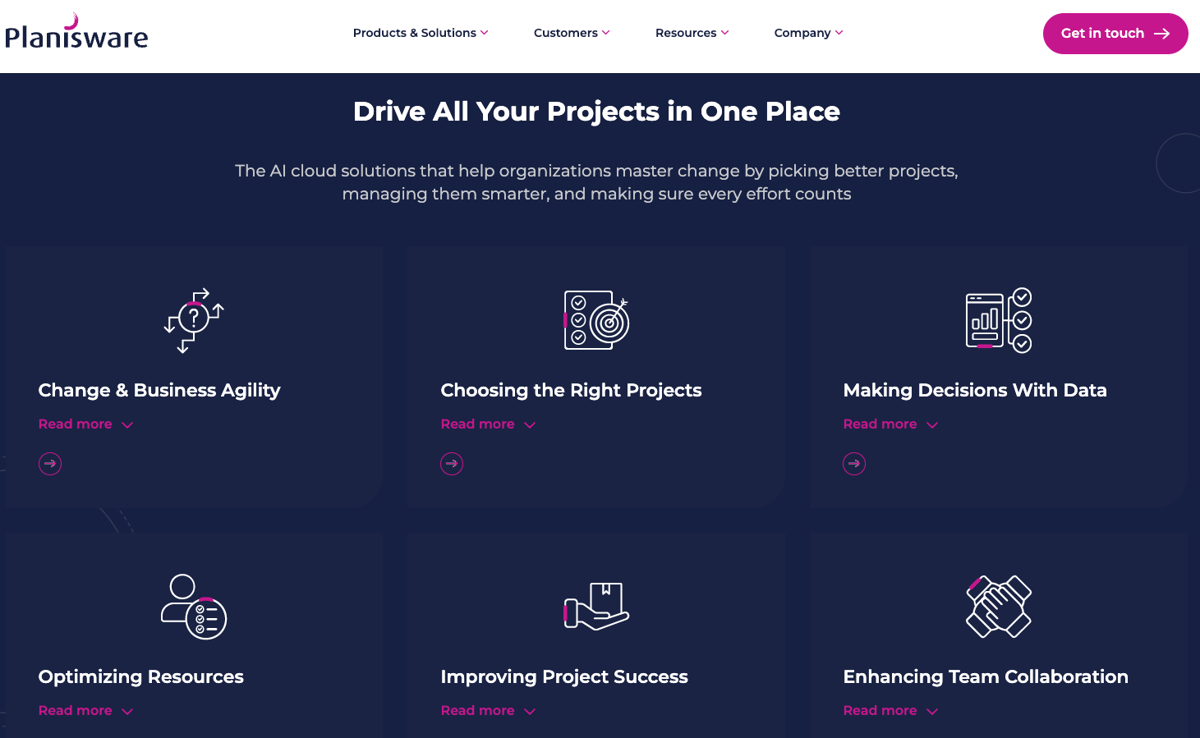
Planisware is built to manage portfolios, and it does this well. But Accolade is specifically made for managing global innovation ecosystems. You can see this contrast in focus by comparing the ways both vendors describe their solutions on their home pages.
Planisware is project- and portfolio-oriented:
Whereas when Wellspring (the makers of Accolade) describes what it does, it’s all about innovation:

Enterprises use both platforms for similar work, but the people making them position them as different types of solutions.
Planisware Is Configurable; Accolade Is Hyperconfigurable
When it comes to enterprise innovation management software, configurability is everything. Planisware has some strong configurability chops: you can create bespoke data fields and metrics, custom workflows, and ad-hoc reports. But Accolade does all this and more.
Accolade gives you more freedom when it comes to configuring relationships between data fields. In Accolade, you can create bespoke, complex entities within the system. You can make any kind of “thing” you need by tying together different data (or classes of data) together. Your project portfolio hierarchy can be matrixed in multi-dimensional ways, just like your organization is. This means that an innovation project portfolio stands a better chance of mirroring your enterprise’s operations in Accolade than it does in Planisware.
Plus, Accolade supports self-service configuration. You can set up these custom reports, workflows, and data relationships yourself, and you don’t need any prior programming or database expertise to do so. This isn’t the case with Planisware: custom configurations will involve its professional services team.
Accolade Handles Front-End Innovation; Planisware Does Not
Here’s where the language gets a bit tricky. At the enterprise level, true innovation management is more about orchestrating portfolios than sourcing ideas. But to the general software-buying community, “innovation management software” usually refers to ideation and technology scouting solutions.
That’s not what Planisware is for. It’s an industry-leading SPM/PPM platform, not a front-end innovation management system.
On the other hand, Accolade is an end-to-end innovation management platform, and that includes support for front-end activities. You can run idea campaigns, collect submissions, and set up ideas as their own entities in Accolade. You can create and iterate opportunity-specific processes to move ideas through development and validation in Accolade. You can design ad hoc tech scouting workflows, reports, and permissions in Accolade, and you can even run AI-assisted technology scans.
If you’re considering Planisware for running your innovation portfolio, Accolade should be part of that conversation.
Planview: More Strategic Focus
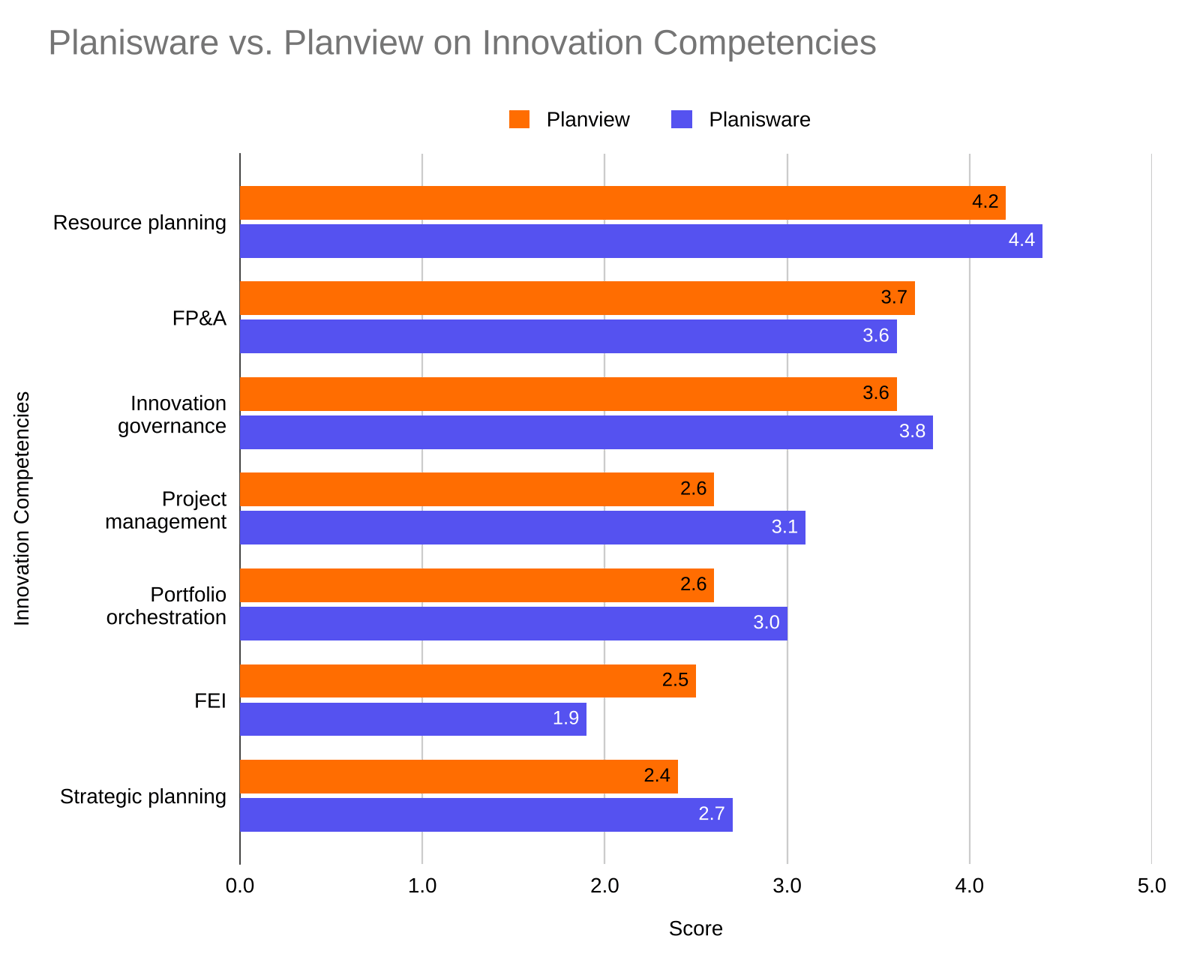
Planview is the other member of the big three to consider. Similar to Planisware, Planview is positioned as a powerful SPM and PPM solution. However, while Planisware is more configurable, Planview has the stronger strategic feature set.
That’s consistent with how its websites present these solutions. Just like Planisware and Accolade take different approaches to framing their solutions, Planisware and Planview pick different lanes right away on their home pages. Planisware puts project portfolios front and center, while Planview focuses on connecting strategy and execution.
This focus on strategy correlates with Planview gaining an edge on Planisware in idea management, reporting, and decision-making.
Planview Is Stronger in Idea Management
A big part of innovation strategy is sourcing and validating the right ideas. So it follows that the more strategy-oriented SPM would also have the stronger feature set for this kind of work. While Planisware earned a score of 2.2 (out of a possible 5) in idea management, Planview earned a 4.0.
This is primarily a product of Planview’s flexibility. Planview gives you more control over:
- The design of your opportunity management process
- Idea campaign setup and distribution
- Idea submission management
- Idea evaluation metrics
Planview doesn’t have the technology scouting support that Accolade and some of the smaller FEI solutions do, but its idea management features can contend with every other vendor’s on this list.
Planview Is Slightly Stronger in Reporting
Planview’s reporting capabilities aren’t light years ahead of Planisware’s; they’re pretty comparable. However, our research found that Planview has a more robust data visualization library, and building custom reports is slightly easier in Planview than it is in Planisware.
Planview’s Decision-Making Tools Are Easier to Use
In our analysis, the big three are almost equivalent when it comes to decision-making support. All of them earned top marks on custom decision process design, submission and approval controls, and change monitoring.
However, Planview edges out Planisware on ease of use. Based on what we could find, Planview requires no database or programming skills to set up bespoke decision processes. You don’t need to be a developer to use Planisware, but you’ll probably need some practice to get the hang of it.
FEI-Focused Planisware Alternatives: Itonics, Hype, and Qmarkets
If you’re thinking of innovation management primarily from a front-end perspective (ideation, tech scouting, etc.), you should also consider the following three options. These are what people more traditionally consider “innovation management systems.”
But remember: these are not SPM or PPM systems. These players outscore Planisware strictly in enabling FEI competencies; Planisware beats them all in the other six areas. They’re point solutions for managing the process of getting new concepts into the innovation portfolio, not for managing the portfolio itself.
If you’re looking for an alternative to Planisware for innovation-focused portfolio management, stick with Accolade and Planview.
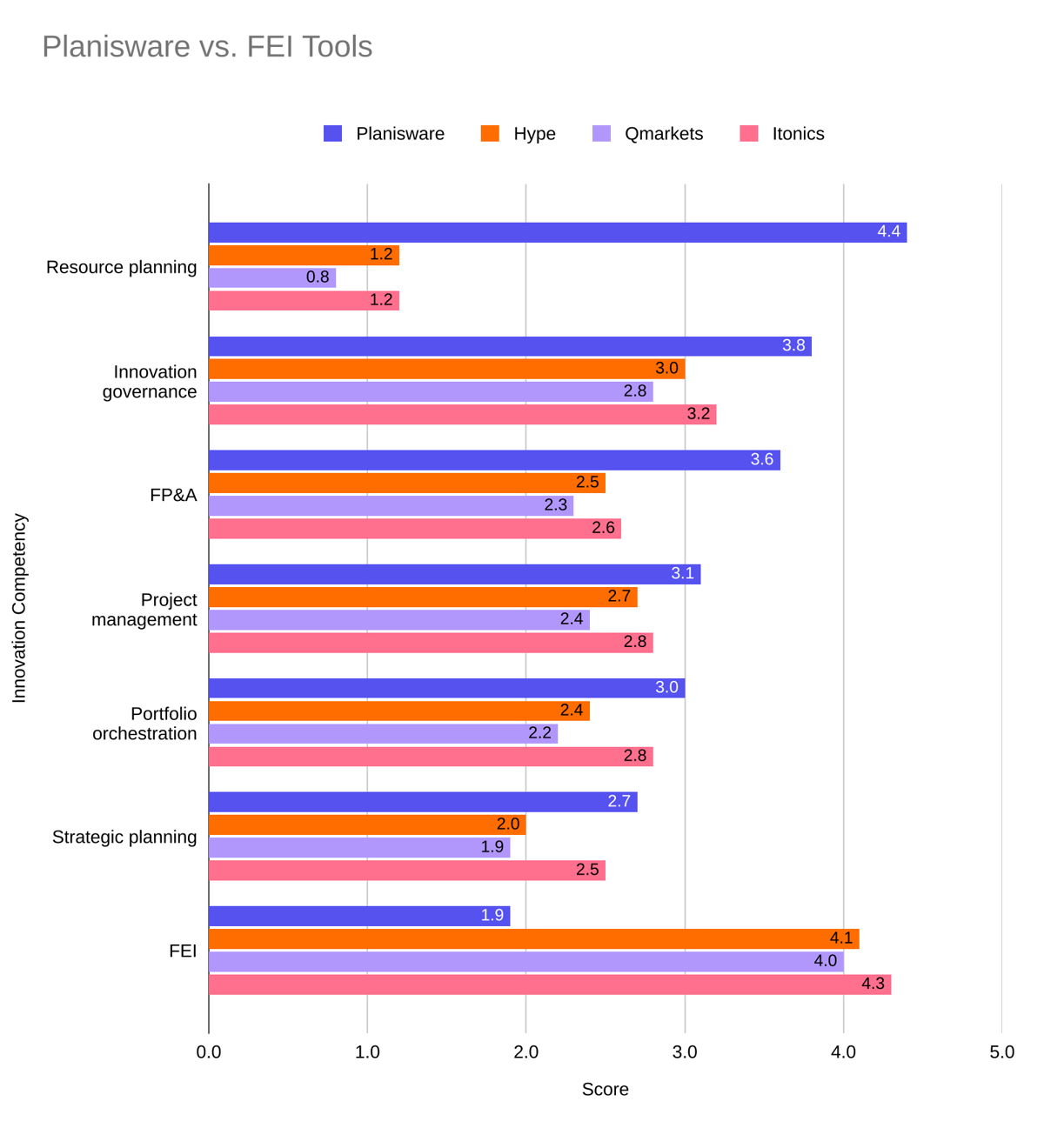
Itonics: Best Planisware Alternative for Technology Scouting
In our research, Itonics topped the charts for opportunity identification capabilities. They’re a full FEI management system, with robust idea management features on par with Accolade and Planview.
Hype Innovation: Best Planisware Alternative for Idea Management
Hype got top marks in terms of idea management features. Hype users can configure their entire ideation and validation process to their enterprise, creating bespoke idea types, evaluation metrics, and workflows.
Qmarkets: A Balanced Planisware Alternative for Front-End Innovation
While Itonics takes tech scouting and Hype takes idea management, Qmarkets scores right between the other two alternatives on both. (And of course, Qmarkets scores are better than Planisware’s in both areas too.)
Choosing a Planisware Alternative
In summary, here’s how we recommend conceptualizing pure-play alternatives to Planisware:
|
The Best Planisware Alternatives for Enterprise Innovation Management |
|
|
Brand |
Best for |
|
Accolade |
Global enterprises looking for a single end-to-end solution for managing innovation portfolios |
|
Planview |
Global enterprises looking for a strategy-oriented SPM/PPM |
|
Itonics |
Companies looking for a front-end innovation management solution with strong tech-scouting capabilities |
|
Hype |
Companies looking for a better way to run and manage ideation |
|
Qmarkets |
Companies looking for something between Itonics and Hype |
But this is just our take. If you’re considering Planisware (or trying to switch out of Planisware), you should develop your own solution criteria. Our guide to choosing an enterprise innovation management system walks you through the process of doing this; check it out here. You might also want to pick up our buyer’s guide for selecting an EIM solution.
And of course, we’d love to show you how Accolade compares. Book a demo with us and we’ll show you how it works.
Frequently Asked Questions
What is the best alternative to Planisware?
Accolade is the best Planisware alternative for enterprise innovation management, with an overall score of 4.3 out of 5 compared to Planisware’s 3.2. Accolade is built specifically for managing innovation rather than portfolios alone, it’s hyperconfigurable without professional services or programming expertise, and it supports front-end innovation activities like idea campaigns, opportunity-specific processes, and AI-assisted technology scans.
How were these Planisware alternatives scored?
Each system was graded on a 70-point rubric measuring its ability to enable seven innovation competencies: strategic planning, resource planning, financial planning and analysis, portfolio orchestration, innovation governance, project management, and front-end innovation. Scores focus on growth outcomes and span the entire innovation lifecycle, so FEI-focused tools were still graded on portfolio capabilities. All scores were assigned by Wellspring, the makers of Accolade, based on research that included interviews with people who have used other systems.
How does Planisware compare to Accolade?
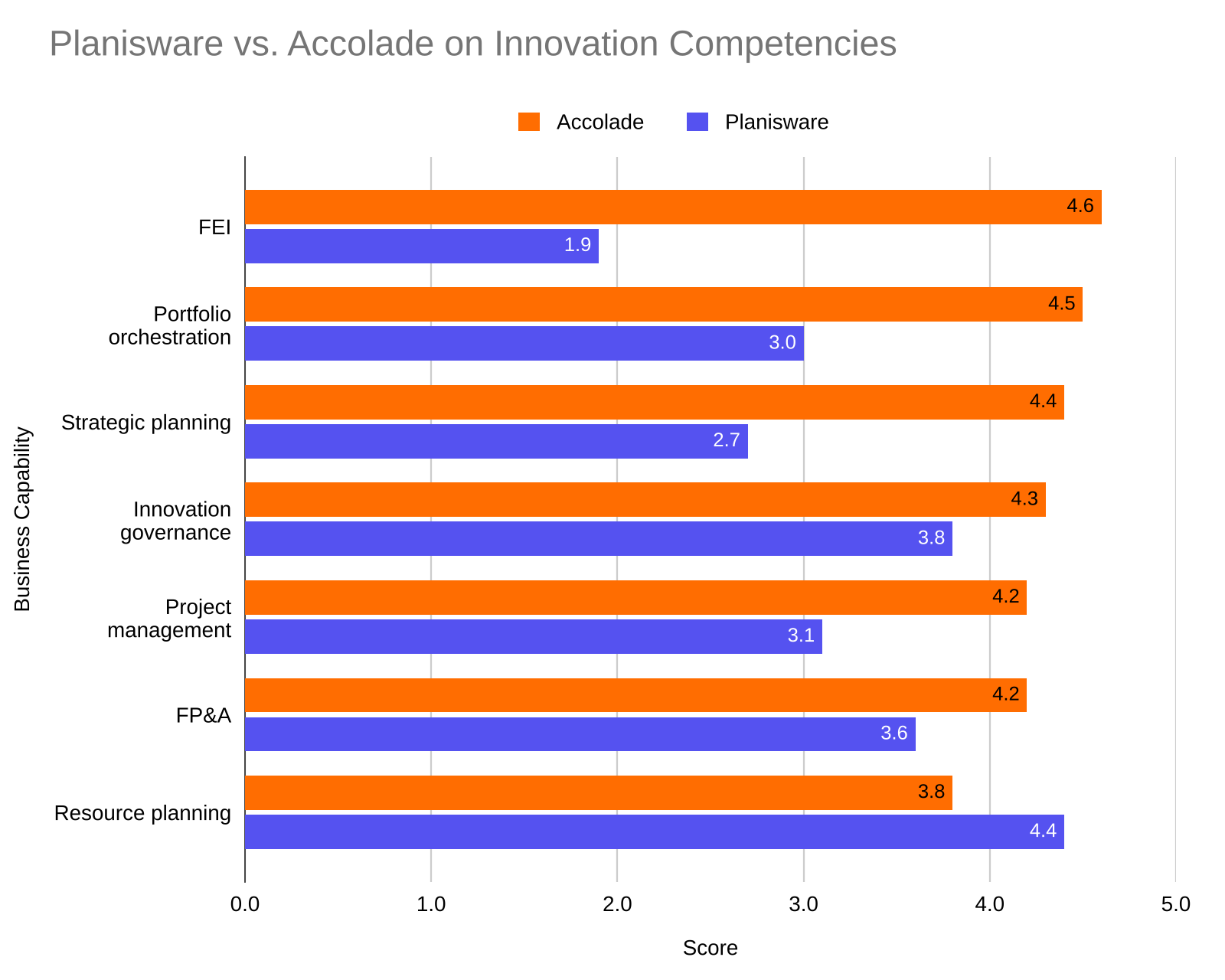
Planisware is portfolio-first, while Accolade is innovation-first. Both are configurable, but Accolade lets you build complex, matrixed data relationships, custom reports, and workflows yourself, while custom configurations in Planisware typically involve its professional services team. Accolade also scores far higher in front-end innovation (4.6 vs. 1.9). Planisware’s biggest relative strength is resource planning, where it outscores Accolade 4.4 to 3.8.
How does Planview compare to Planisware?
Planview and Planisware are both powerful SPM and PPM solutions. Planisware is more configurable and earned a slightly higher overall score (3.2 vs. 3.0), while Planview has the stronger strategic feature set. Planview scored 4.0 in idea management compared to Planisware’s 2.2, offers a more robust data visualization library, and requires no database or programming skills to set up bespoke decision processes.
Are Itonics, Hype, and Qmarkets good alternatives to Planisware?
Only if your focus is front-end innovation. Itonics, Hype, and Qmarkets outscore Planisware in FEI, but Planisware beats all three in the other six competencies. They’re point solutions for getting new concepts into the innovation portfolio, not SPM or PPM systems for managing the portfolio itself. For innovation-focused portfolio management, Accolade and Planview are the stronger alternatives.
Which Planisware alternative is best for technology scouting or idea management?
Itonics topped our research for opportunity identification capabilities, making it the strongest pick for technology scouting. Hype Innovation earned top marks for idea management, letting users configure bespoke idea types, evaluation metrics, and workflows. Qmarkets scores between the two on both, making it a balanced option for front-end innovation.