

Quick summary
An enterprise innovation management (EIM) system connects a global company’s innovation pipeline to its growth goals. It covers strategy, resources, budgets, governance, project execution, and new ideas in one platform. Wellspring, the maker of Accolade, scored six leading EIM vendors in spring 2026. The rubric used 70 vectors, grouped into 16 solution capabilities and seven business competencies.
Overall scores (out of 5):
Accolade: 4.3
Planisware: 3.2
Planview: 3.0
Itonics: 2.7
Hype: 2.5
Qmarkets: 2.2
Key takeaways:
-
Accolade scored highest in strategic planning, portfolio orchestration, innovation governance, project management, financial planning and analysis, and front-end innovation.
-
Planisware and Planview lead in resource planning, with top marks in resource requisitioning and utilization tracking.
-
Hype earned a perfect 5 in idea management. Itonics earned a perfect 5 in opportunity identification.
-
Enterprise configurability is the one capability that affects every business competency, so it deserves the most weight in any evaluation.
-
Evaluation approach: Judge EIM software as a growth enabler, not a cost center. Build your RFP around outcomes, not feature lists.
What’s the greatest all-time NFL team? Who is your basketball G.O.A.T.? How about the best movie ever? We could break out Madden Football and NBA 2K and run all the simulations, or cross-reference the AFI 100 against the IMDb Top 250, but what would any of it prove? Championships aren’t won on paper. Oscars aren’t awarded on star power and box office draw. The best (the 1989 49ers, Michael Jeffrey Jordan, and The Shawshank Redemption) are crowned on the field, the court, and in the hearts of movie goers. It’s no different with enterprise innovation management (EIM) software.
A global enterprise juggles hundreds, if not thousands, of simultaneous initiatives in its innovation pipeline, and without the proper tools, it becomes impossible to see into the black box of all these aggregate details.
Traditionally, organizations have attempted to solve this issue by stitching together project management tools or ERP modules. But this really only enables organizations to track what’s happened or schedule what needs to be done. The best solution would alleviate innovation’s administrative burden and facilitate its daily execution all while ensuring that every stakeholder has the visibility they need to make the best decisions. This is where EIM software comes into play.
The right EIM software becomes your innovation’s central nervous system, providing the visibility and functionality necessary to manage the entirety of your pipeline and ensure projects stay aligned with the goals that got them greenlit in the first place.
In this guide, we’ll help you evaluate enterprise innovation management systems so that you can make the right choice for your organization. You’ll learn about the various innovation categories they influence, the solution capabilities that impact and improve outcomes in each category, and how to build an effective RFP.
What this guide covers:
Core Principles for Navigating This Guide
EIM Buyer’s Guide Scoring Methodology
The Outcomes an EIM Solution Should Provide
How the Best Vendors Compare in Various Business Competencies
Interpreting Vendor Performance Across Core Competencies
Core Solution Capabilities: The Functional Requirements for Business Competencies
Document and Deliverable Management
Resource Utilization and Cost Tracking
The Next Steps in Choosing an EIM Solution
Defining Business Requirements and Technical Requirements
Assessing Your Growth Innovation Maturity
Appendix: EIM System Scoring Methodology
Want to get straight to the scores and comparisons?
But before we jump into the details, let’s get a few caveats out of the way.
Important Context for Buying an Innovation Management System at the Enterprise Level
To get the most out of this resource, there are a few foundational principles you’ll need to keep in mind as you map potential vendors to your organization’s requirements.
1. This Guide Is Intended for Global Enterprises
We do not evaluate the whole universe of innovation tools. This guide is designed for global enterprises that manage complex product portfolios, operate across multiple geographic regions, and oversee numerous business units and product lines. Consequently, we focus on the enterprise-grade tools that help organizations balance multiple product-line extensions while investing in new R&D initiatives.
When we say this guide focuses on enterprise innovation management solutions, the word “enterprise” is doing a lot of heavy lifting.
2. Your RFP Should Focus on Outcomes, Not Just Features
The best RFPs originate from clearly articulated requirements and desired outcomes. Starting with outcomes in mind elevates critical questions like “How does your platform aggregate cross-departmental data so our executive committee can make informed resource allocation decisions?”
The better you are at defining the outcomes you want to see in your workflows, data accessibility, and governance mechanisms, the more likely you are to get what your enterprise actually needs.
3. EIM Solutions Are Growth Enablers, Not Cost Centers
You can’t evaluate an EIM solution the same way you’d evaluate a new payroll system. If you look at this decision through a cost-efficiency lens, you’ll miss the actual contributions an EIM solution can make. Sure, an EIM tool will help you trim administrative overhead, but that’s not the overarching goal. Growth is the most critical contribution you should expect from an EIM solution, and you should appraise EIM options through a growth innovation lens.
Growth innovation is an innovation management philosophy that sets growth as the single most important innovation outcome and manages every step of the innovation process accordingly. Enterprises aren’t innovating for innovation’s sake; they innovate to ensure future revenue. Growth innovation ensures that every decision and action puts growth in the spotlight. The EIM tool you choose should help facilitate that end.
Should an EIM solution streamline your Stage-Gate processes? Of course. But it has to go beyond reducing the friction in your pipeline. An EIM enables growth when it allows you to do things like:
- Ensure better collaboration and visibility by giving every stakeholder access to the data they need when they need it.
- Quickly diagnose and axe unproductive projects, and reinvest resources into more worthwhile efforts.
- Safeguard your strategy by ensuring initiatives and projects stay aligned with the goals that got them greenlit.
- Monitor interdependencies across every project in your portfolio, so you can quickly discern how a pivot will impact other timelines and initiatives.
Combined with the right approach to innovation management, the right EIM will increase new product revenue, accelerate time to market, and reduce your spend on project management.
4. Selecting and Implementing an EIM Solution Is Time-Consuming (and It Should Be)
Stop for a second and think about every person, system, and process that’s part of your innovation process. An EIM system will impact every one of those facets. Aligning everyone around a solution is time-consuming enough, but then you have the technical, security, and compliance considerations, too.
Once you choose a solution, the implementation process will take some time. You’ll need to configure it to your own operations, integrate it with other systems, migrate your existing innovation project data into it, and potentially deprecate tools that it makes obsolete. And then you’ll need to onboard and train your teams to use it.
Getting up and running with a new EIM solution requires a significant time investment, and you should be wary of any vendor that tells you otherwise.
EIM System Buyer’s Guide: Scoring Methodology
To create a comprehensive guide, we mapped out everything innovation enterprises need to consider.
We started by identifying every business competency that an EIM system should be able to facilitate or improve. This list of seven competencies included areas like portfolio orchestration, strategic planning, and front-end innovation (FEI).
We then asked ourselves, “How does EIM software enable this competency?” This led us to 16 solution capabilities that mapped to the previously identified business competencies. These included idea management, reporting, and scenario modeling. We weighted each capability based on how vital they were to those competencies.
But that wasn’t granular enough. We also wanted to determine which factors were necessary to enable each solution capability. This led us to identify 70 individual vectors that power the solution’s capabilities.
To summarize, our scoring rubric contains:
- 70 individual vector scores, weighted into:
- 16 solution capabilities, weighted into:
- 7 business competence scores, weighted into:
- Final EIM scores
We took this rubric and used it to grade the top six competitors in the EIM space:
- Accolade
- Planisware
- Planview
- Hype
- Qmarkets
- Itonics
This buyer’s guide walks you through how each of these vendors compares in every area. You’ll be able to draw some useful conclusions about how each one might impact your innovation process, and select the enterprise innovation management system that’s best suited for your organization.
NOTE: You can check out the appendix for a more detailed look at the scoring methodology. Parts of this scoring process are subjective, and if you feel we reached some of these conclusions in error, please reach out and let us know.
Key Outcomes Enterprise Innovation Management Solutions Should Enable
Considering EIM solutions through the lens of growth enablement changes your evaluation criteria. You stop simply counting features and interfaces and begin examining each solution’s ability to drive tangible growth outcomes.
That’s why in this section we want to examine the specific innovation competencies that an EIM tool should augment:
- Strategic planning
- Resource planning
- Financial planning and analysis
- Portfolio orchestration
- Innovation governance
- Project management
- Front-end innovation (FEI)
1. Strategic Planning: Bridging the Gap Between Executive Planning and Innovation Execution
The right enterprise innovation platform should help craft an innovation growth strategy, and then keep execution aligned with that strategy.
EIM capabilities such as scenario modeling and revenue stream planning help executive teams map out growth strategies that are more resilient to macroeconomic changes and competitive disruption. Mathematically stress-testing potential paths means that plans don’t have to be made in a vacuum. They can project long-term outcomes before committing capital to specific projects.
Once the strategy is set, your EIM platform should help you execute it. As a matter of course, innovation projects drift from the plan. An EIM tool should help you create a workable roadmap for each project and provide the guardrails needed to ensure it stays on the right path.
2. Resource Planning: Managing Resource Capacity and Preventing Innovation Bottlenecks
Every project and initiative pulls from the same finite pool of resources, and juggling specialized teams and equipment is integral to balancing your strategic portfolio. An EIM platform should provide the visibility needed to prioritize projects and ensure your resources are guiding the right ones to completion at the right time.
This takes more than retroactive tracking. It requires predictive capacity planning that maps demand against capacity and availability. When you have to pivot on a project, your EIM system should automatically calculate the impact on your teams. Resource managers should be able to identify potential bottlenecks months in advance so that stakeholders can hire or outsource projects before things grind to a halt.
Generic project management tools are not a substitute. It’s easy to offer generic tracking sheets and call that resource planning. An EIM tool that offers genuine resource planning should be able to recognize interdependencies across geographical boundaries, so you can see bottlenecks coming six months out.
3. Financial Planning and Analysis: Monitoring Innovation Spend Based on Real-Time Risk Assessment and Reporting
To truly assist in enterprise innovation, an EIM tool needs to provide more than spreadsheets for setting budgets and tracking expenses. You should expect it to support the real work of FP&A: managing your financial exposure and providing capabilities like risk analysis and real-time reporting. EIM management tools should ensure you’re not funding stalled projects or carrying unmanaged financial risk.
If a team fails to upload the required deliverables at a gate, the platform should automatically withhold funding until it meets performance metrics. Executives should have role-specific dashboards that compile expected ROI in real time, track actual-vs.-budget spend, and probability-weighted financial risk throughout the portfolio.
4. Portfolio Orchestration: Coordinating Diverse Projects and Initiatives to Hit Targets
Managing project portfolios in a global enterprise is tough enough, but truly strategic portfolio management is impossible without the proper tools. Every project represents unique execution requirements and lifecycles, and the pieces of that project may involve multiple teams, departments, territories, and even business units. Many progress through the pipeline requiring unique adaptations to the standard methodology, and each has its own risk profile.
An effective EIM platform offers more than rigid roadmaps that fall out of date as soon as they’re created. It compiles data from active projects and gives leadership a real-time view of milestones and launch dates. When projects change, it maps out the interdependencies and updates the roadmap dynamically.
Portfolio orchestration in a global organization requires a highly configurable platform that adapts to your operations and methodologies. If an EIM tool forces your biochemical R&D team to use the same gating checklists as your product development teams, adoption will suffer. You need a tool that’s flexible enough for various business units and teams, yet can still aggregate those inputs into a standardized dashboard. This allows everyone to work in the way that makes them most productive while enabling you to manage a single, cohesive portfolio.
5. Innovation Governance: Standardizing Governance Throughout the Pipeline
An EIM platform should help you translate the chaotic world of innovation into a discipline that’s structured and repeatable, standardizing decision-making, enforcing stage-gates, and automating compliance.
Traditional EIM tools are built on rigid database structures. The vendor might show you how its tool will help enforce Stage-Gate, but if an FEI team needs to split a stage or introduce a specific compliance check for the European market, you’re in trouble. EIM tools built for enterprise growth allow you to tailor governance to your organization’s unique needs.
Consider the importance of a tool that provides intelligent automation to your distinct workflows. By automatically enforcing specific governance rules, it allows people to spend less time chasing down executives for perfunctory approvals or attending endless alignment meetings. Look for a tool that detects incomplete requirements, automates reminders to the right individuals, and keeps a record of every scorecard and “go/no-go” decision.
6. Project Management: Unifying Execution and Timely Delivery on a Single Platform
As a project management platform, EIM software needs to bridge the gap between the portfolio managers’ higher-level focus and the day-to-day execution of your teams on the ground. An EIM tool should provide a canvas where daily collaborative effort naturally feeds into the strategic portfolio view.
This is achieved by combining useful project design tools with 360-degree visibility and automated status reporting. Teams shouldn’t be forced to duplicate their efforts by managing tasks in one tool and reporting about them in another. Your EIM platform should consolidate all that work into one place. You want a system that automatically updates the roadmap and generates real-time reports as cross-functional teams collaborate. This way, an executive doesn’t need to wait for the next status meeting for an update if a project is falling behind schedule.
A global enterprise has diverse processes and methodologies. One division may be working on a software-powered IoT device that requires an Agile approach, while another is focused on a Stage-Gate manufacturing project. Your EIM should support hybrid methodologies side by side within a single project management tool.
7. Front-End Innovation (FEI): Capitalizing on Market Signals to Capture Valuable Ideas
Too many ideation tools create a black hole where suggestions and ideas go in, and nothing comes out. But EIM tools that accelerate growth give ideation structure and improve technology scouting.
This starts with the ability to capture market trends and competitive signals so that opportunities aren’t missed, teams can track emerging technologies and consumer needs, and campaigns remain focused on specific problems and genuine challenges. As ideas come in, they shouldn’t just go into a black hole. The system should help identify the best ones and provide a direct pipeline into the development process.
The most mature EIM products allow teams to track opportunities from startups, university labs, and independent researchers. This includes providing a platform for initial screening evaluations, feasibility rubrics, and deal structuring.
How the Best Vendors Compare in Various Business Competencies
To give a clearer picture of enterprise EIM solutions, we knew we couldn’t rely on feature checklists. By analyzing leading vendors in the EIM space against an enterprise’s core competencies, we can provide a more complete picture of each vendor’s strengths in managing global enterprise innovation.
We’ve evaluated these EIM platforms across these seven core business competencies. Each vendor has been assessed and scored on a scale of 1 (minimum capability) to 5 (enterprise-grade competency).
|
EIM Vendor Business Competency Matrix |
||||||
|
Business competency |
Accolade |
Hype |
Itonics |
Planisware |
Planview |
Qmarkets |
|
Strategic planning |
4.4 |
2 |
2.5 |
2.7 |
2.4 |
1.9 |
|
Resource planning |
3.8 |
1.2 |
1.2 |
4.4 |
4.2 |
0.8 |
|
Financial planning and analysis |
4.2 |
2.5 |
2.6 |
3.6 |
3.7 |
2.3 |
|
Portfolio orchestration |
4.5 |
2.4 |
2.8 |
3 |
2.6 |
2.2 |
|
Innovation governance |
4.3 |
3 |
3.2 |
3.8 |
3.6 |
2.8 |
|
Project management |
4.2 |
2.7 |
2.8 |
3.1 |
2.6 |
2.4 |
|
Front-end innovation |
4.6 |
4.1 |
4.3 |
1.9 |
2.5 |
4 |
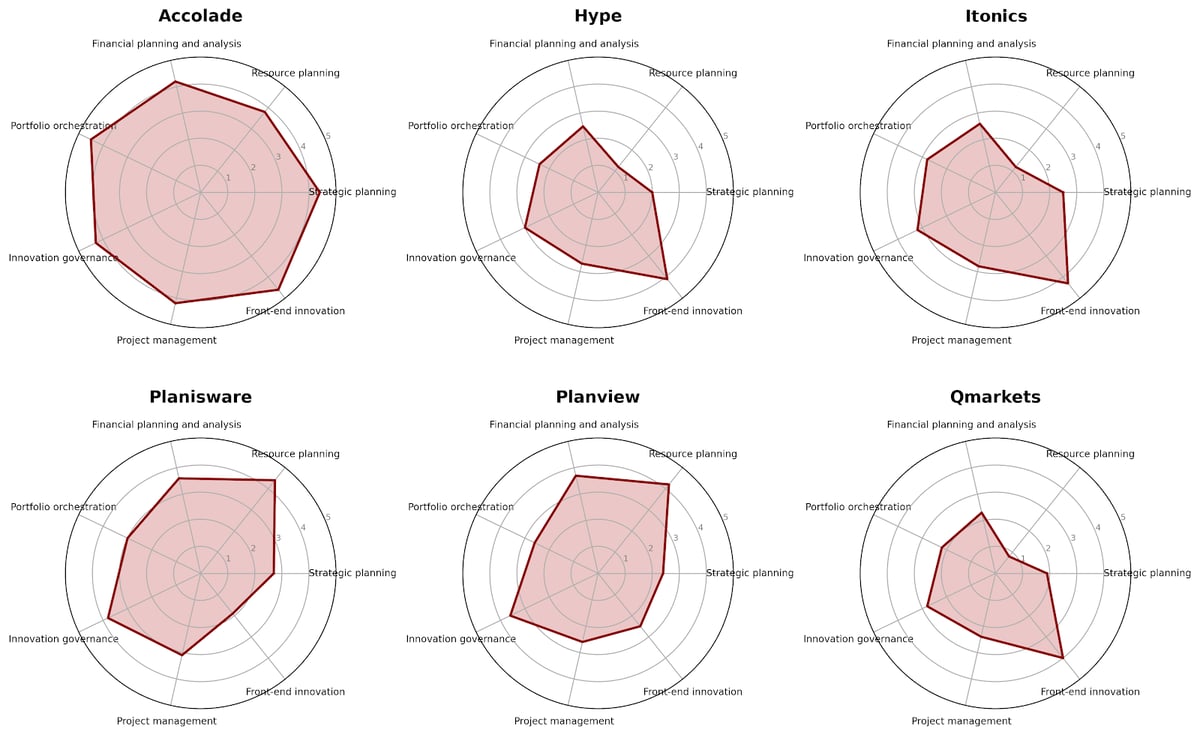
Interpreting Vendor Performance Across Core Competencies
This guide will dive more granularly into the specific capabilities that helped determine these competency scores. But this high-level scoring can help us determine where these tools are strongest.
Accolade: 4.3/5
Accolade dominates in strategic planning (4.4), portfolio orchestration (4.5), and innovation governance (4.3) because it was built to link high-level enterprise growth goals with pipeline execution. It also holds the highest FEI score (4.6) as the tool with the strongest connection between growth objectives, front-end opportunities and ideas, daily operations, and financial planning (4.2). While still highly competent, resource planning (3.8) is where it scored lowest and faces the most competition from the other EIM tools.
Planisware: 3.2/5
Planisware’s highest score is in resource planning (4.4), and it also scores a respectable (3.8) in governance, making it a strong choice for organizations seeking a highly regimented innovation process. The lower scores in FEI (1.9) and strategic planning (2.7) suggest that it treats innovation as an execution problem. If you’re looking for help finding opportunities and managing ideas, look elsewhere.
Planview: 3.0/5
Similar to Planisware, Planview excels at resource planning (4.2). It’s also fairly strong in FP&A (3.7). You’ll find it useful for tracking which projects each developer or engineer is spending their time on and for managing innovation budgets, but when it comes to portfolio orchestration (2.6), project management (2.6), and front-end innovation (2.5), the scores average out.
Itonics: 2.7/5
When it comes to front-end innovation (4.3), Itonics shines. It also scored above average in governance (3.2). When it comes to ideation and protocol management, it delivers. But with a resource planning score of 1.2, Itonics users will face limitations in managing downstream innovation on a global scale.
Hype: 2.5/5
Hype delivers strongly in the FEI (4.1) category, making it a strong choice if you’re looking for a tool to manage ideas and surface new opportunities, but its resource planning (1.2) and strategic planning (2) scores show that it falters when it comes to turning ideas into products that deliver on revenue targets and corporate objectives.
Qmarkets: 2.2/5
Qmarkets handles idea management well, earning a 4.0 in FEI. It has lower scores in strategic planning (1.9) and resource planning (0.8), which means that global enterprises using Qmarkets will likely need to pair it with another SPM tool or ERP system.
Core Solution Capabilities: The Functional Requirements for Business Competencies
In this section, we’ll break down each business competency into the features and capabilities that power it. We’ll also look at the various functions that assist in these capabilities.
Finally, we’ll assess how each vendor delivers on those functions and capabilities.
Enterprise Configurability
“How well does the EIM system create a meaningful digital representation of an enterprise’s innovation activities?”
No organization manages innovation complexities in exactly the same way. This is why a rigid EIM tool isn’t going to be overly helpful, no matter how feature-packed it is. Enterprise configurability is the secret sauce of any substantial EIM solution, and it’s the only capability in this guide that plays a significant role in every business competency.
If the platform is too inflexible, the business will end up forcing unnecessary changes to accommodate the tool. You don’t want a system forcing you to drastically alter your workflows. This negatively impacts adoption rates. If you spring a new tool on specialized teams that needlessly modifies how they operate and communicate, you can expect half-hearted acceptance if not outright resistance.
Configurable IM solutions give users the freedom to map data to their unique needs. This begins with whether it allows you to link data into specific relationships that best reflect your processes. Can you create custom metrics and strategic goals, and then break them down into multidimensional hierarchies? Can teams manage this on their own, or does it require an in-house specialist or a professional service?
If modifying your data, workflows, and governance requires vendor consultation, the total cost of ownership for the EIM tool goes up as your productivity grinds to a halt.
Another critical consideration is how the tool manages security. Are teams locked into rigid user roles? The needs of a global enterprise might go beyond custom roles, extending to non-role-based rules. For example, you might want to give everyone with a PhD in chemistry access to a specific dataset. Can the tool do that? If so, does it require outside help or specialized coding?
The more configurable an EIM solution is, the more autonomy an enterprise has to maintain processes that work and evolve as necessary.
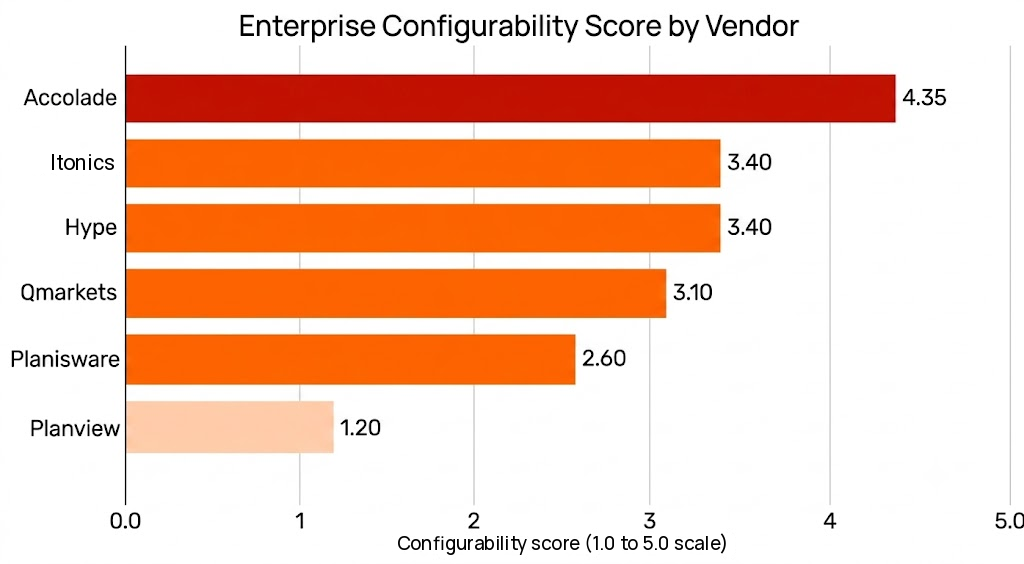
Enterprise Configurability Scores by Vendor
After aggregating the scores across a number of vectors, Accolade earns the top spot with an enterprise configurability score of 4.35. It outperforms the competition by delivering flexibility without making enterprises dependent on vendors or requiring heavy in-house coding skills.
Reporting
“How well does the tool enable innovation stakeholders to determine innovation portfolio status, history, and health?”
An IM platform needs to improve visibility. Real-time dashboards have become a foundational expectation for every vendor, and the real test isn’t whether it can display your data, but how flexible it is with the data it serves up.
Template-based reporting is limiting: it won’t show you a project’s cross-functional dependencies or the bespoke metrics unique to your portfolio makeup. Growth-oriented EIM solutions move beyond templates, allowing for custom calculations on any field or metric and letting you map directly to organizational growth goals.
However, customizable reporting isn’t the only consideration. You also need to consider whether generating custom reports requires an on-site programmer or paid professional services from the vendor. Ideally, custom reports require minimal to no programming skills and no professional services.
There’s also the question of how that data will be presented. There’s a spectrum of data representation in EIM tools, with some solutions providing default tables and others providing elaborate, comprehensive visual libraries that render information in brand-specific heat charts, risk matrices, and other useful graphics.
Lastly, we can’t skip AI’s emerging impact on reporting. As it stands, nearly every vendor has LLM agents that can explain charts to users, offer instructions on creating reports, or even generate reports for you. But we can expect AI-embedded EIM platforms to eventually intuit and create reports based on user behavior. This is definitely an area where you’ll want to get a vendor’s input on how its tool will be evolving because these solutions will look nothing like they will in a couple of years.
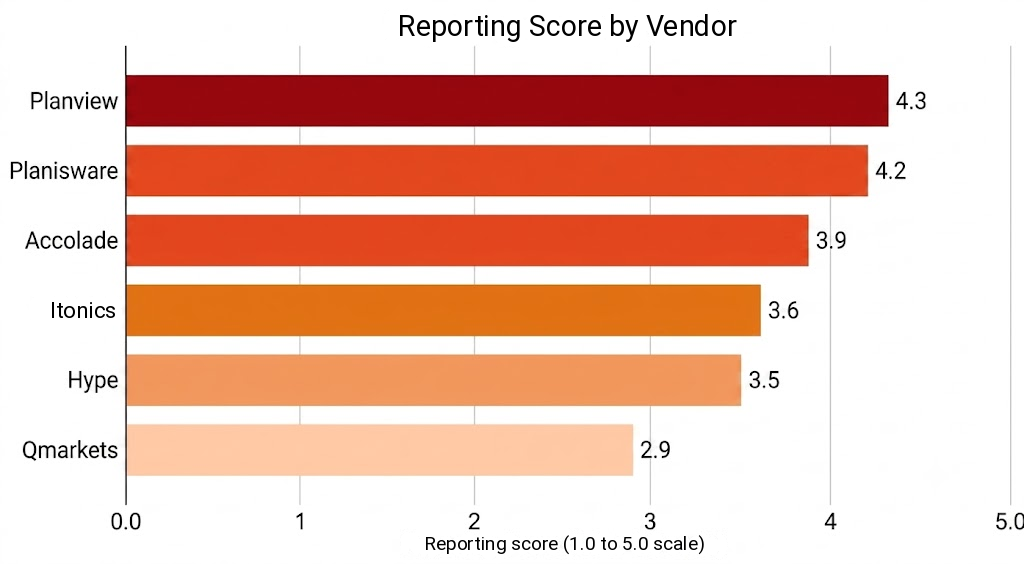
Reporting Scores by Vendor
Planview barely edges Planisware out of the top spot with a score of 4.3. Both Planview and Planisware’s reporting lead is in part due to early AI integration.
Roadmapping
“How will this tool help us set a course that helps individual projects hit their milestones while keeping the portfolio on course?”
When an EIM platform has roadmapping dialed in, projects stay aligned with strategic intent. But this takes more than a calendar or Gantt chart.
A robust roadmapping solution visualizes project interdependencies and builds composite views of initiatives across multiple horizons and organizational objectives. In the most mature EIM solutions, a roadmap isn’t a single static feature. It’s integrated into the whole EIM ecosystem. No enterprise innovation roadmap exists in isolation, so it’s important to know that when a project deadline is missed, the system updates the other impacted roadmaps.
When evaluating an EIM system’s roadmapping capabilities, it’s important to take into account accessibility and ease of use. Your various stakeholders are looking at a roadmap for different details. Executives want a high-level strategic view, while product managers are more focused on granular milestone tracking. The ability to tailor role-based views becomes incredibly helpful, along with easy exporting and sharing. If maintaining complex roadmaps requires specialized database skills or professional services, it is challenging to get the most out of this capability.
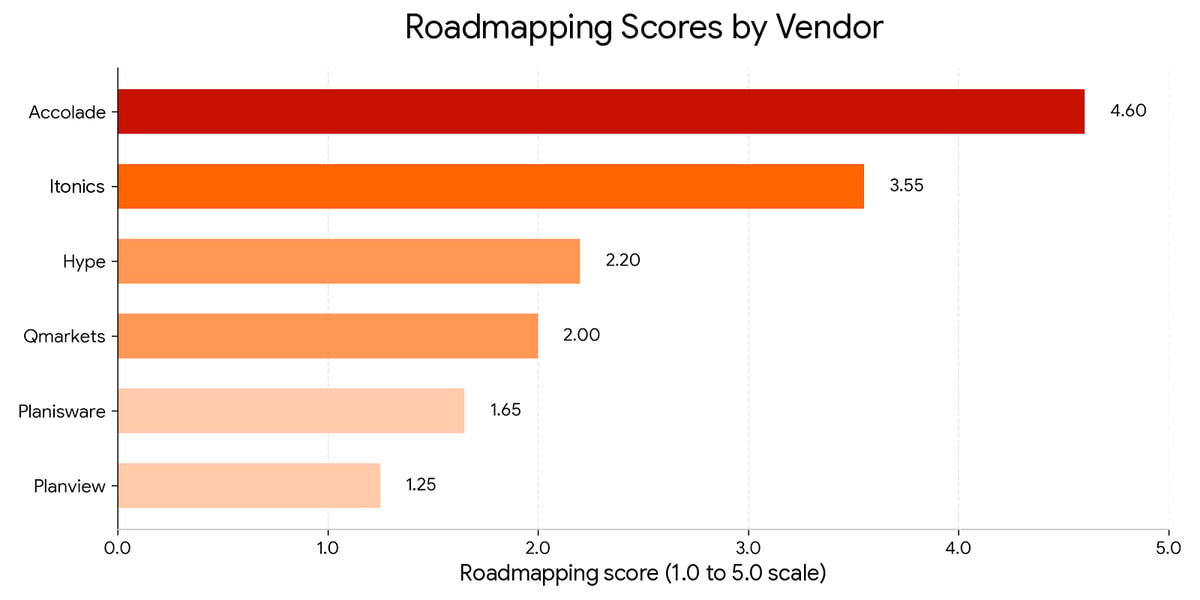
Roadmapping Score by Vendor
Accolade comes in first with a score of 4.6. This is driven by a perfect score in its roadmap integration capabilities. Accolade allows users to see the ripple effects of changes throughout the pipeline, including resource capacity and availability.
Accolade also excels in roadmap visualization. You can decide what users see based on their roles and modify roadmaps to fit the organization’s needs. It also allows you to visualize composite roadmaps so that you can see everything in the pipeline intended to fill a specific revenue gap, contribute to a specific initiative, or meet the custom criteria of your choice.
Scenario Modeling
“How will this tool help us evaluate potential outcomes so we can choose the most productive path forward?”
Priorities shift. Budgets rearrange. Markets fluctuate. And your competitors are always making their own moves. Leaders need to anticipate and adapt to changes like these by simulating possible futures.
When evaluating an EIM solution that offers scenario modeling, it’s important to evaluate how flexible it is in generating scenarios and how useful it is in comparing them. Can you create, clone, and iterate multiple scenarios? Can you incorporate specific constraints, such as capital or resource limits? Does the tool allow for comparative views so you can contrast scenario options?
Another critical scenario modeling element is how the system handles an approved scenario. A useful EIM platform will help by automating the rollout and translating the scenarios into the requests and steps necessary to move from “what if?” to “now this.” Once execution begins, it’s important to know whether the system will allow you to compare planned performance against actual performance and alert managers when things are deviating from the scenario so adjustments can be made.
Since scenario modeling is such an executive-coded function, usability is critical. If building a scenario requires technical expertise, the feature won’t get used as regularly as it should. An enterprise-grade EIM solution should remove barriers, putting scenario building in the hands of portfolio managers.
Scenario Modeling Score by Vendor
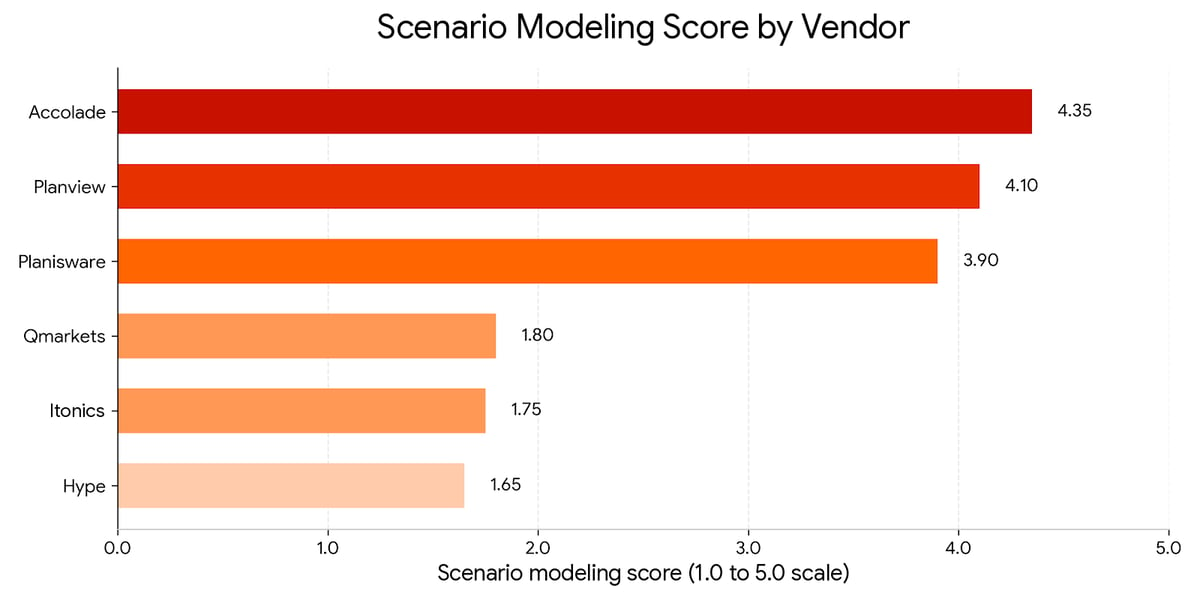
Scoring the highest possible marks in scenario generation, scenario visualization, scenario comparison, and planned-vs.-actual scenario tracking pushed Accolade to the front of the pack with a score of 4.35.
Document and Deliverable Management
“How will this EIM solution help us manage all of our documentation in ways that improve execution?”
Managing enterprise innovation means managing documents and project deliverables. The best EIM solutions centralize this information and build meaningful relationships between documents that accelerate execution.
AI will play an increasingly critical role in this area. An AI-empowered EIM system doesn’t just store files; it can scan, cite, and summarize this documentation. It will also update documents or create new ones based on natural language commands. As EIM platforms mature in this area, keep your eye out for the ones that allow you to restrict AI access to sensitive documents.
Document and Deliverable Management Scores by Vendor
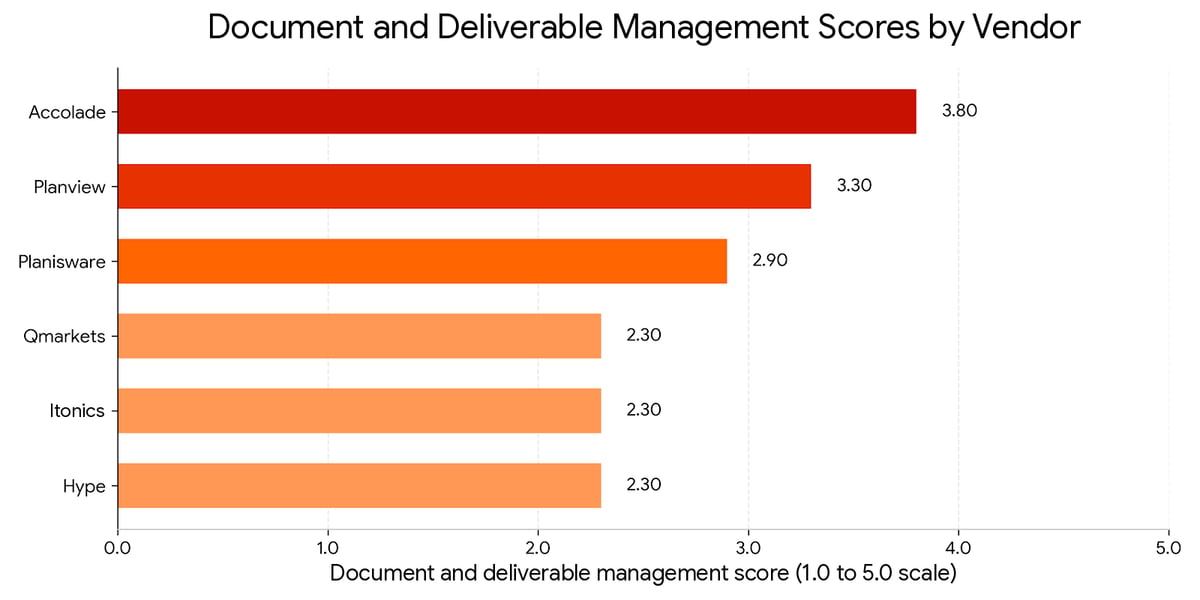
Accolade is the best EIM system for document and deliverable management, leading the pack with a 3.8. Accolade allows you to link documents to projects as you deem necessary while supporting access and version control. It also receives the highest marks for its Office 365 integration.
Revenue Stream Planning
“How well does the IM system enable decision makers to plan and review portfolios by revenue stream?”
Growth innovation is all about revenue streams: mitigating decay in existing streams and spinning up new ones. Your innovation management system should make clear connections between the projects in your pipeline and the strategic financial purposes behind them.
At a bare minimum, a platform might support custom tags that allow managers to label projects by the revenue stream they’re targeted to fill. More sophisticated systems go further, recognizing revenue streams as dedicated entity types with custom attributes, multidimensional hierarchies, and bespoke attributes. This level of categorization allows leadership to aggregate and filter the most complex portfolios by revenue origin.
When it comes to revenue stream design, basic platforms might allow you to group existing projects into financial buckets. On the other end of the spectrum, more advanced EIM platforms enable you to set revenue stream targets for projects, forecast revenue stream gaps, and assign priorities and portfolio mixes to specific streams.
An EIM tool should enforce connections between newly created projects and the revenue streams they represent. Advanced EIMs will support ad-hoc ERP data pulls and automatically sync project-level ERP data with portfolio targets. In the near future, we can expect to see embedded AI applying ERP revenue data to IM entities by inference.
Revenue Stream Planning Scores by Vendor
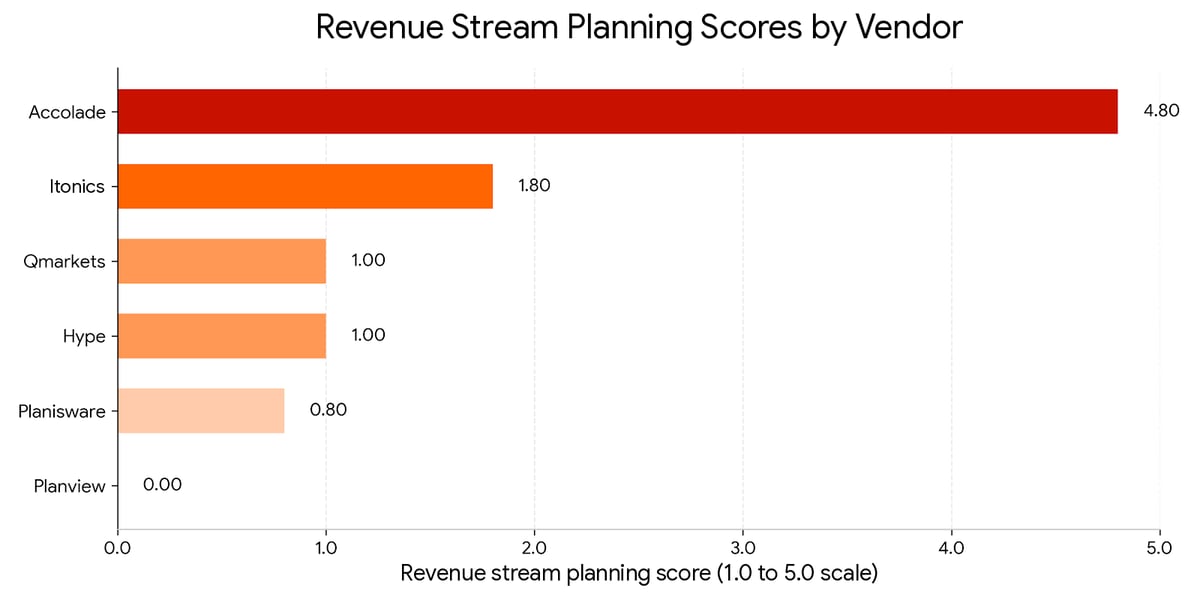
Its commitment to tying enterprise innovation directly to growth puts Accolade far ahead of the pack with a score of 4.8. Every innovation project should be immediately linked to a revenue stream, and Accolade’s EIM solution makes that link easier to establish and manage.
Resource Requisitioning
“How well does the IM system enable managers to request and approve resource assignments?”
Resource requisitioning connects portfolio planning to project execution. You might have a brilliant revenue strategy, but you’ll still need to staff the projects that will bring it to fruition. So one question you should ask when considering EIM options is, “How well does this platform enable managers to request and approve resource assignments?”
Your EIM solution should embed structured requisition forms right into the project process. Ideally, when projects pass gate approvals, the platform automatically triggers resource requests, logging them directly to the relevant project entity. The best EIM solutions may even go a step further by analyzing capacity and availability to ensure that managers aren’t making impossible allocation requests.
When it comes to approvals, enterprise-grade EIM tools should warn managers if approving a request will over-allocate certain resources. And it may even allow for a rules-based automatic approval process for some requests.
By baking smart requisitioning and automatic approval/denial mechanisms into your EIM system, you can deploy people faster and maintain complete visibility over your capacity.
Resource Requisitioning Scores by Vendor
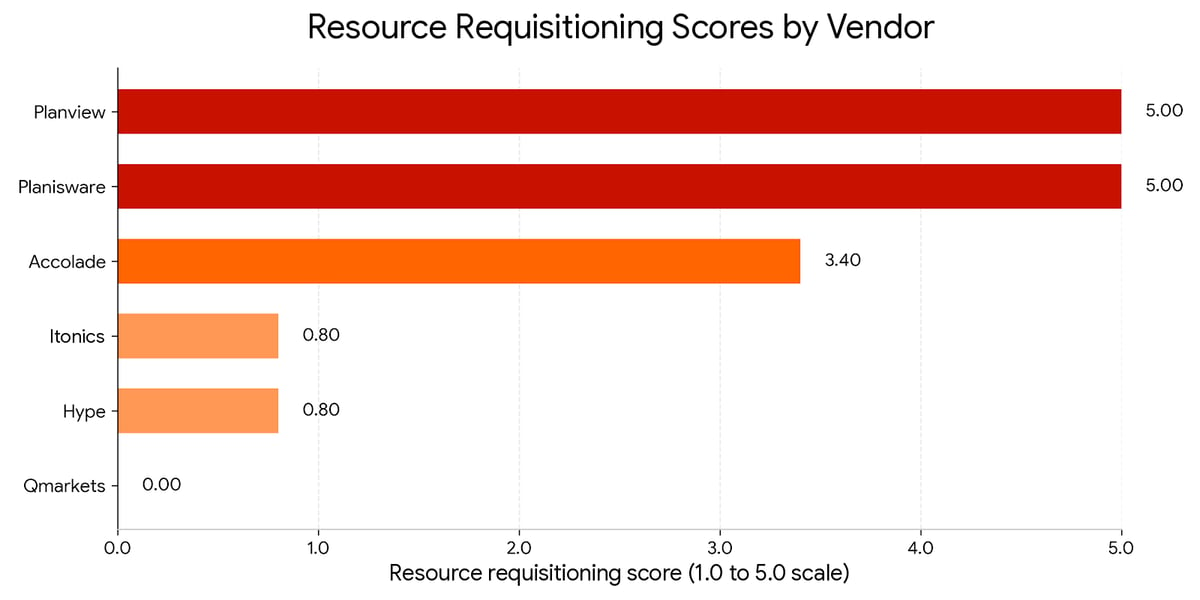
Both Planview and Planisware score a 5 in resource requisitioning, getting top marks in their solution’s ability to handle submissions, approvals, and automate resource commitments.
Strategic Resource Planning
“How well does the IM system enable managers to view and plan resource availability?”
Strategic resource planning enables portfolio managers to model, track, and optimize both human and non-human resource use across the enterprise so that you don’t delay launches and burn through innovation budgets. The right EIM platform offers the visibility necessary to balance demand across business units and ensure that finite resources are committed to the highest-priority initiatives.
An EIM solution should recognize personnel, facilities, and equipment as dedicated entity types within your pool of resources. It should also support custom attributes so managers can categorize resources with some granularity, like filtering engineers by technical certifications or indexing specialized labs by region. An enterprise-grade system can then build on this baseline by enforcing rules-based prioritizations to prevent the most limited assets from being assigned to low-priority projects.
The best strategic planning requires a nuanced view of capacity that goes beyond simple availability binaries. Your EIM system should be able to model partial bandwidth and shared equipment, syncing availability against project timelines. When forecasted demand exceeds capacity, it should highlight potential bottlenecks and allow managers to model potential scenarios for rebalancing capacity.
Strategic Resource Planning by Vendor
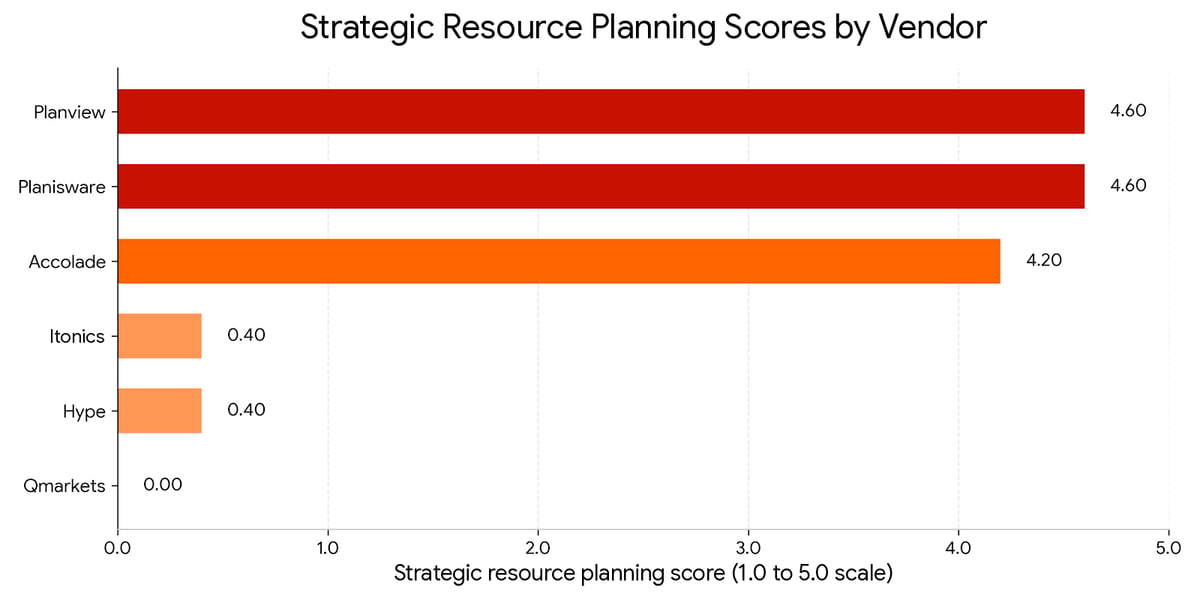
Planisware and Planview both take the top spot with a 4.6. As EIM solutions, both platforms make it easy to ensure resources are used effectively and never overextended.
Resource Utilization and Cost Tracking
“How well does the IM system enable managers to track resource utilization and costs?”
Managers need to understand how resources are being used and how that impacts the bottom line. An enterprise-grade innovation management system should make this possible.
A basic entry-level resource utilization tool would likely include manual timecard collection where members log their hours right into the platform. As they become more sophisticated, they’ll have an out-of-the-box tracking tool or a bespoke one. At the highest level, an EIM system allows for multiple custom systems for tracking utilization and can track individual resources across those different systems at the same time — for example, translating a single chemist’s month of work into the appropriate metrics for the three matrixed projects she’s working on.
A high-performing EIM in this area also translates resource use to the bottom line. Resource cost tracking can be handled by the EIM itself or via integration with your financial management system.
Resource Utilization and Cost Tracking Vendor Score
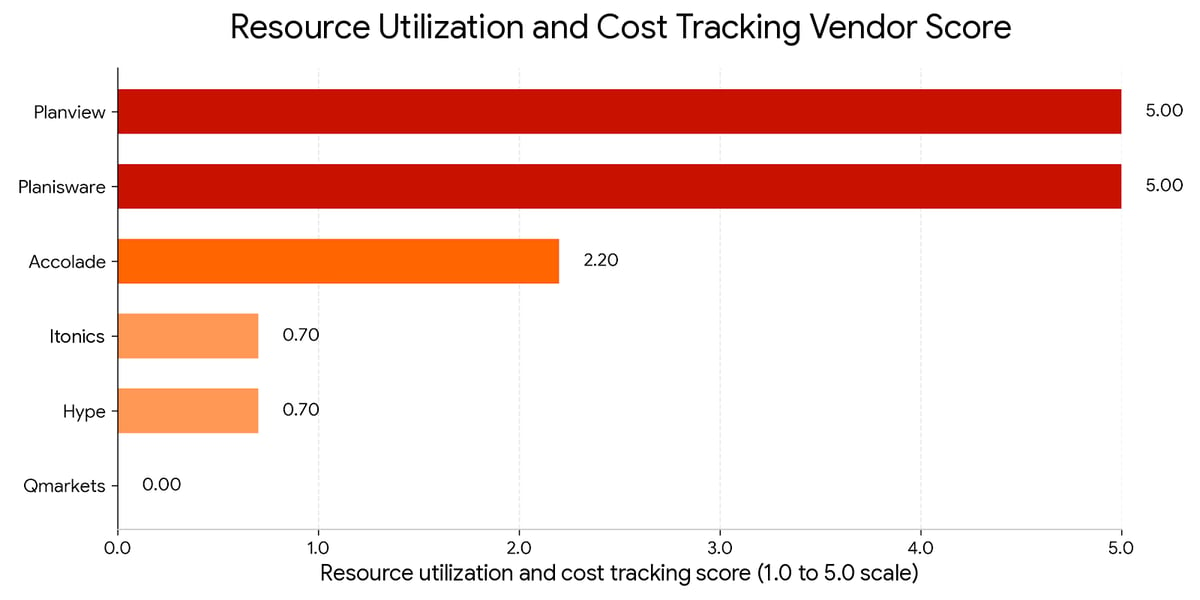
When it comes to tracking resource utilization and associated costs, Planview and Planisware scored a perfect 5. Both vendors have prioritized this function within their tool.
Financial Planning
“How well does this EIM tool integrate with our financial system?”
Most of your financial planning takes place in your dedicated financial system, but an enterprise innovation management system can elevate the level of financial visibility innovation leaders have when making strategic decisions. Tools with high scores in this area streamline the flow of data from the financial system to the EIM so that leaders can import (or even automatically sync) financial data to their innovation portfolios.
Financial Planning Score by Vendor
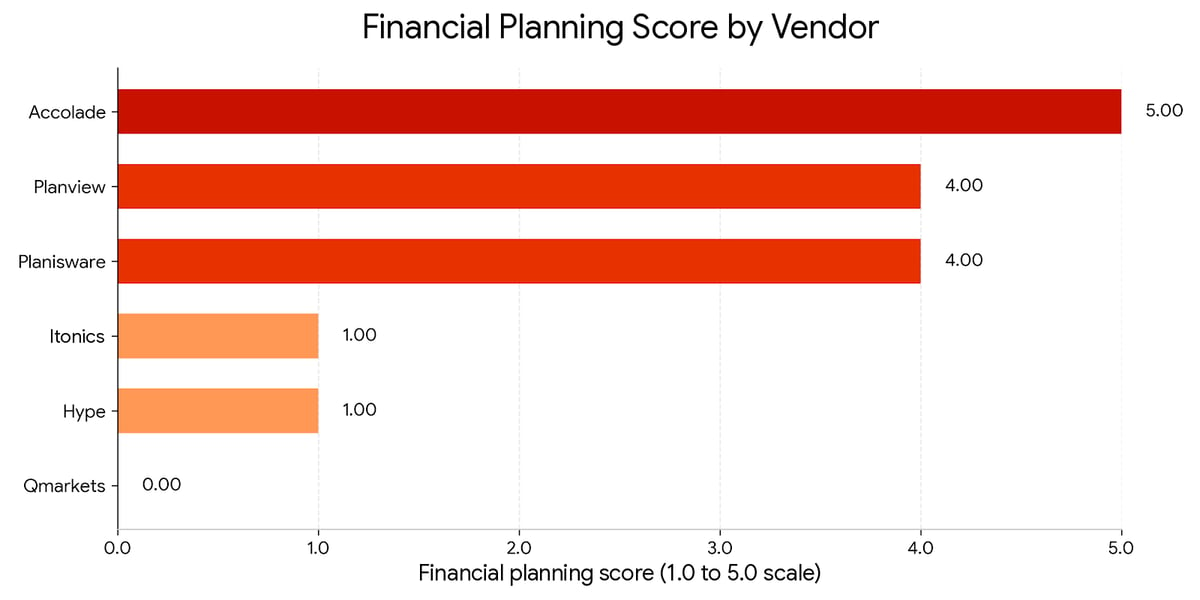
Accolade lands a 5 with its automated financial syncing capability. Planview and Planisware come in right behind Accolade, allowing manual, two-way synchronization between their solutions and financial platforms.
Risk Management
“How well does the IM system enable managers to view, account for, and mitigate risks?”
An EIM system should alert you to threats before they jeopardize timelines and portfolio value. And enterprise-grade platforms will acknowledge risks as dedicated entity types. They might acknowledge risk with preset attributes or allow for customized attributes. As tools become more refined, a solution might let you map risks to projects, programs, portfolios, and target revenue streams and even allow you to filter portfolios by risk types and severity levels.
Another risk management vector to consider is risk scoring and attribution. A tool might let you manually assign predefined risk severity labels to potential problems, but lack the necessary granularity. It’s more useful to be able to create custom severity levels and apply your own defined thresholds. This allows you to determine the differences between similar projects or closely related risk types. In the best-case scenario, you can create rules that the system uses to automatically change risk scores when project metrics change.
Your EIM should give leadership a clear view of active risks across your portfolio. Hopefully, it also provides structured workflows to capture, track, and resolve them. As agentic AI becomes more fully embedded in EIM, we can expect agents to constantly analyze risk and prompt managers with tips for mitigating any risks that are found before they impact productivity and ultimately revenue.
Risk Management Scores by Vendor
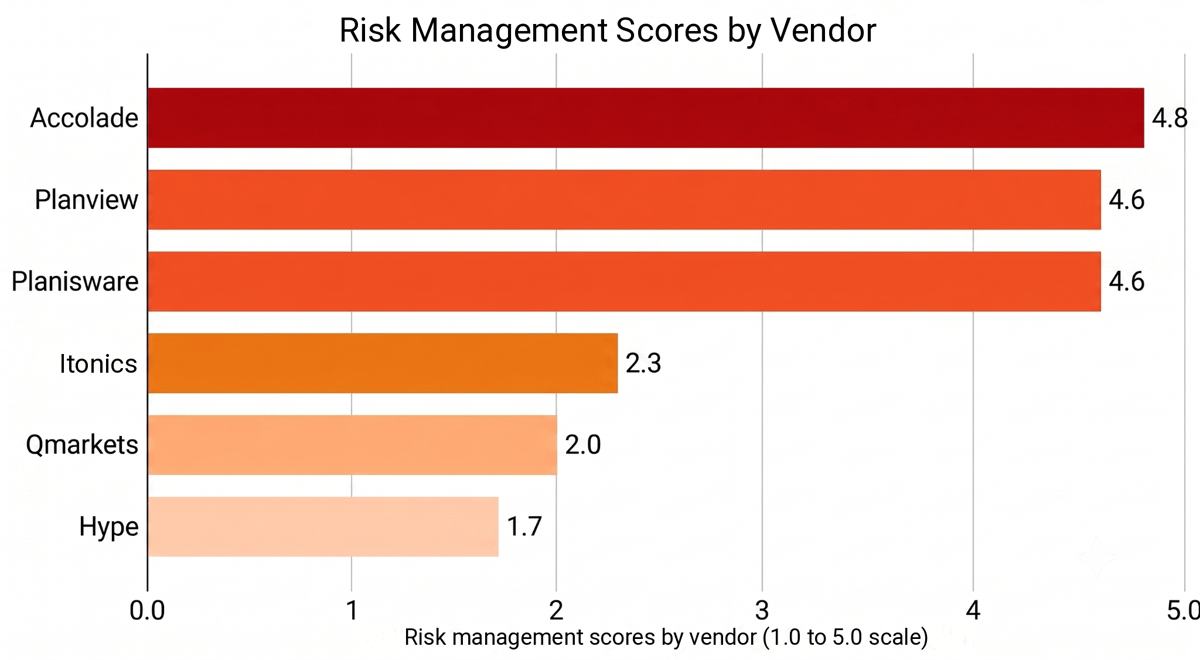
Accolade scores a 4.8, edging out Planview and Planisware in the risk scoring and escalation vector. The ability to create rule-based risk severity thresholds pushed Accolade over the top. Instead of a project manager manually setting a risk status before a monthly check-in meeting, Accolade allows you to set if/then triggers. For example, the system knows that if the budget variance exceeds 15%, it needs to escalate the risk from low to medium.
Decision-Making Tools
“How well does the EIM system enable managers to make go/kill/hold decisions?”
Innovation leaders need to decide whether to greenlight projects, put them on hold, or shut them down. An EIM platform should give leaders the information they need to make these decisions and support the entire process of surfacing, recording, and enacting those decisions.
An enterprise-grade innovation management system captures and reflects your organization’s decision-making processes. It treats decisions as dedicated entity types: the decisions that need to be made can be referenced as their own “things” within the system. Since every enterprise team will need to make different types of decisions, an EIM should also allow users to create custom attribute fields and ad hoc process workflows. If your system does this, then it can capture the decision-making process your managers use as data, which can inform future decisions. (And ideally, it won’t require extensive in-house technical expertise or professional services to design these in your system.)
An EIM should also streamline those decision-making processes. When a decision is submitted for approval, the system should compile all the relevant context managers need (e.g., business cases, risk profiles, resource constraints, etc.) into a single decision profile. A strong EIM will also provide guidance to help managers make these approvals. This can include using scoring and rules logic to suggest whether a decision should be approved or denied, and warning managers who are about to approve decisions that violate governance.
Cutting-edge EIM systems leverage AI decision assistance to turn innovation data into automated intelligence. Embedded agents can explain decision-making processes and operating procedures to users and demonstrate how similar decisions in the past were handled. At its most advanced level, AI agents will eventually be able to analyze complex interdependencies and demonstrate the ripple effects of a choice or model predictive what-if outcomes.
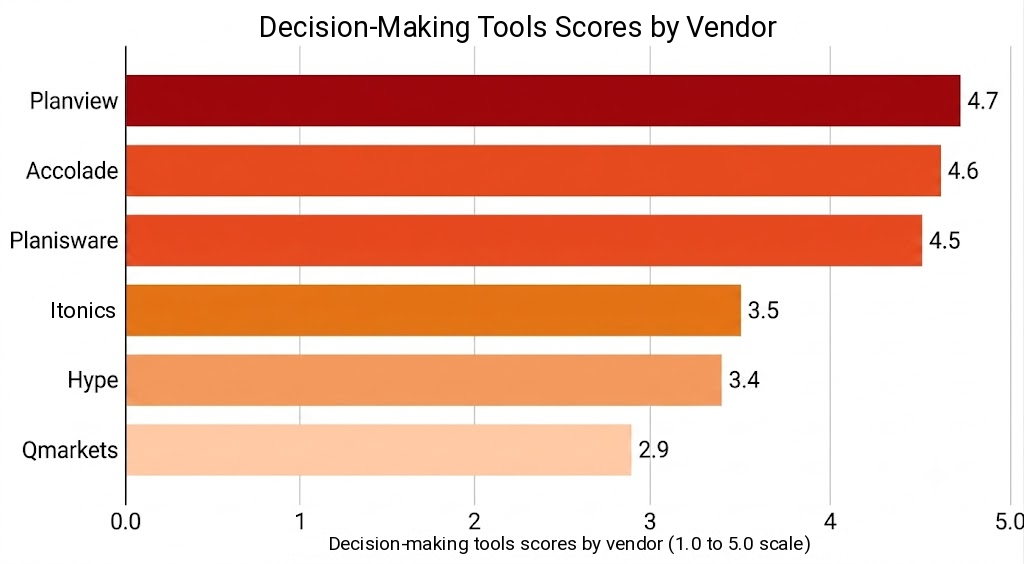
Decision-Making Tools Scores by Vendor
The top three contenders in decision-making tools capability came within fractions of a point of one another. Planview ekes out the highest score (4.7) by scoring a point higher than Planisware in the ease of decision process design and scoring a point higher than Accolade in AI decision assistance.
Project Design
“How well does the EIM system enable managers to create, customize, and integrate projects?”
Innovation involves not only many projects, but many kinds of projects. Your EIM should allow you to set these up efficiently and give you the flexibility you need for projects in the system to reflect the work being done in the real world.
Some legacy platforms force teams to construct every project from scratch or rely on static forms. Higher-tier platforms improve flexibility and expedite setup with bespoke templates and the ability to clone and adapt previous projects. Project creation is further accelerated when fields can be automated based on parent entities, governance rules, etc. At the highest level, embedded AI agents can construct project profiles, populating complex data fields from natural language prompts.
Your EIM should reflect not only the way you structure projects but also the way you structure the relationships between projects. At the lowest project integration level, project creation is limited to single parent-child architecture. Improving on this, some EIM platforms support multi-parent relationships and zero-parent standalone initiatives. At a more complex enterprise level, some even allow for bespoke relationship types and attributes.
Ease of use is important here. Ideally, your EIM will let you design projects without advanced programming skills or expensive professional services from the vendor.
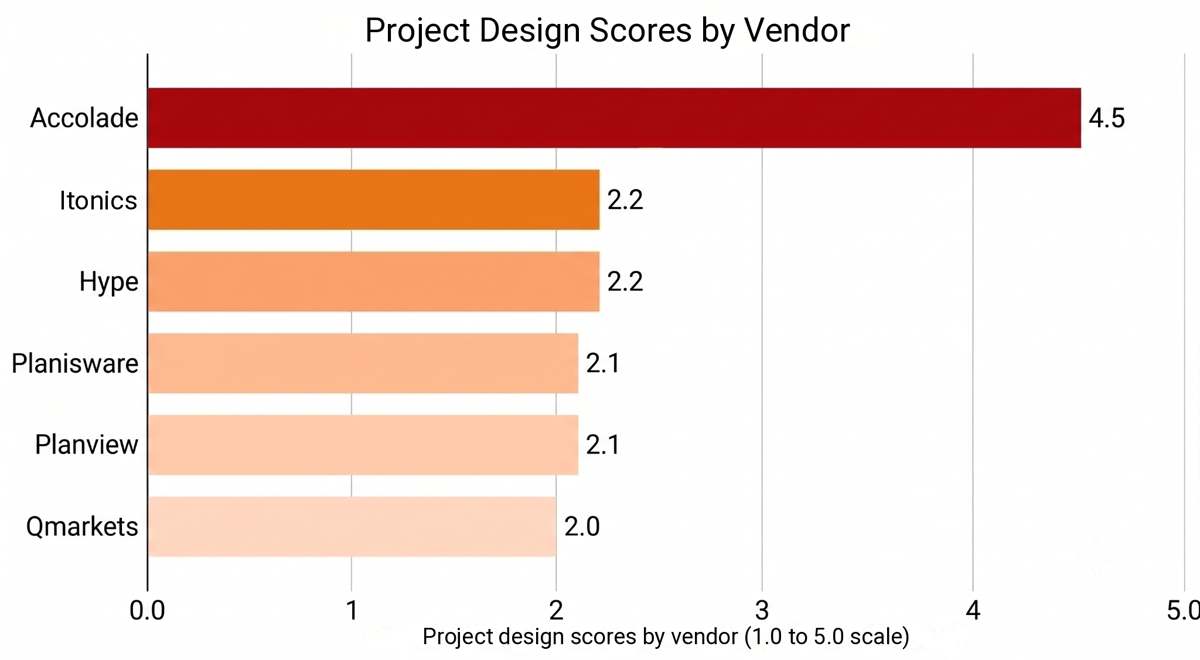
Project Design Scores by Vendor
Accolade scores a 4.5 in the project design capability, differentiating itself from its competitors in the project integration level where it scored a 5, while the nearest competitor scored a 2.
Planisware, Planview, and Accolade all scored high on ease and complexity of project setup; Accolade really distinguishes itself when it comes to integration and ease of use.
Collaboration Tools
“How well does the EIM system enable innovation workers to collaborate on activities?”
Innovation is inherently cross-functional; every single project requires input from numerous departments. An EIM system should make it simpler for various stakeholders and teams to collaborate on a project.
EIM systems progress from tools that allow basic, unidirectional syncs with third-party project management software to ones that include their own project management systems.
When it comes to project management roles, some systems govern workflows with preset roles like project manager or sponsor. Others offer more flexibility, supporting custom roles, bespoke permissions, and rule-based permission controls based on contextual project data rather than roles.
The next consideration is how the platform handles project assignments. At the lowest levels, it should include a queryable and filterable database that can compare resource availability against current project plans. But categorizing a person as 100% available or unavailable doesn’t always reflect the reality of enterprise resources, so more intricate EIM systems allow for non-binary availability distinctions.
As you consider EIM options, pay attention to how they embed communication into their systems. Discussion threads, inboxes for users and teams, and actionable notifications are all good things to look for. And of course, it helps if your EIM integrates with the collaborative tools you already use like Teams, Slack, and Google Workspace.
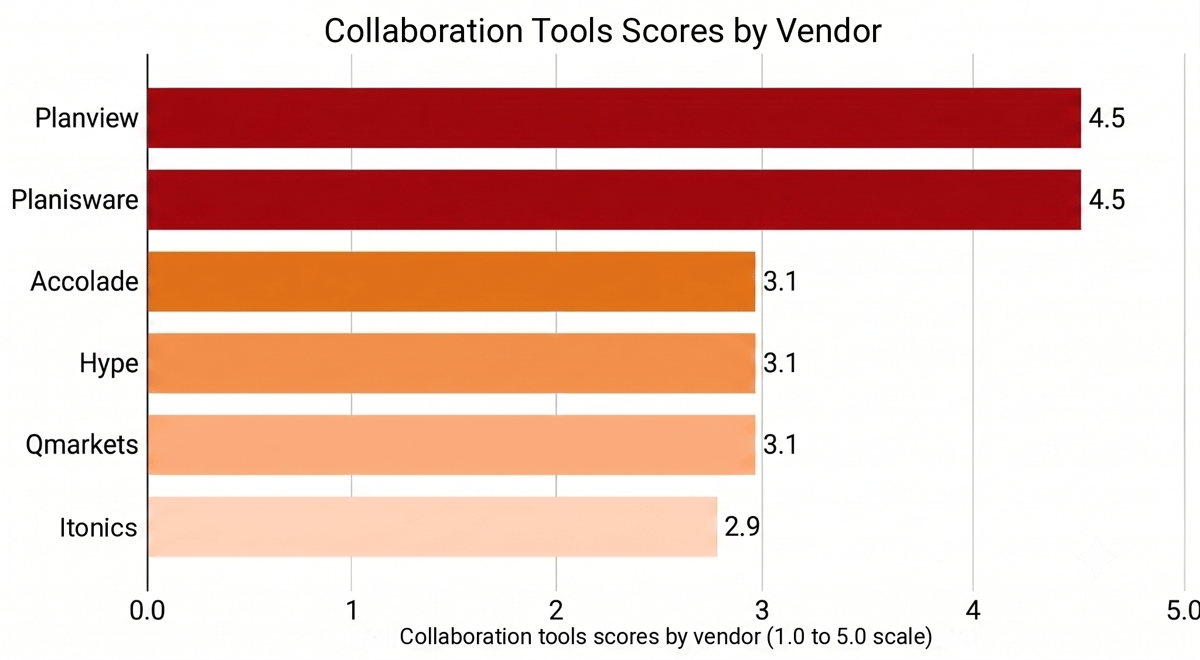
Collaboration Tools Scores by Vendor
Due in large part to their strong showing in the project assignment vector and their in-tool communication functionality, Planview and Planisware scored a 4.5 in this capability, scoring 5s on their systems’ ability to manage complex resource availability and project assignments.
Idea Management
“How well does the EIM system enable innovation workers to manage FEI opportunities?”
An EIM’s idea management capability plays a huge part in how teams source and refine ideas, allowing the best concepts to be identified and structured into valid proposals.
EIM systems with basic idea campaign management identify campaigns as dedicated IM entity types and include submission forms with shareable links. As EIM systems move up in complexity, they allow customization in how campaigns function, including beginning and end dates and automated reminders. They also may include built-in campaign assignment for roles like evaluator or moderator, and tools for distribution (e.g., email, landing pages, etc.).
Evaluating an EIM platform’s submission handling requires looking at areas like visual intake forms, entity linking, and automated classification. At a global enterprise level, solutions should keep ideas in their proper context (e.g., tying idea submissions to relevant product lines, initiatives, market trends, etc.). EIMs can also reduce manual administrative work by automatically tagging, grouping, merging, and de-duplicating ideas as they enter the system. Plus, it’s helpful when your system allows contributors to track their submissions’ status; this way they know they’re not throwing ideas into the void.
When it comes to evaluating ideas, there should be some standard tools like ranking, voting, and prioritization. More complex tools might include custom evaluation metrics and workflows so novel ideas can be evaluated by their own merits instead of through a rigid lens. And you also need to consider how forward-thinking the evaluation tools are: AI can save a great deal of time when it comes to summarizing, clustering, and deduplicating submissions.
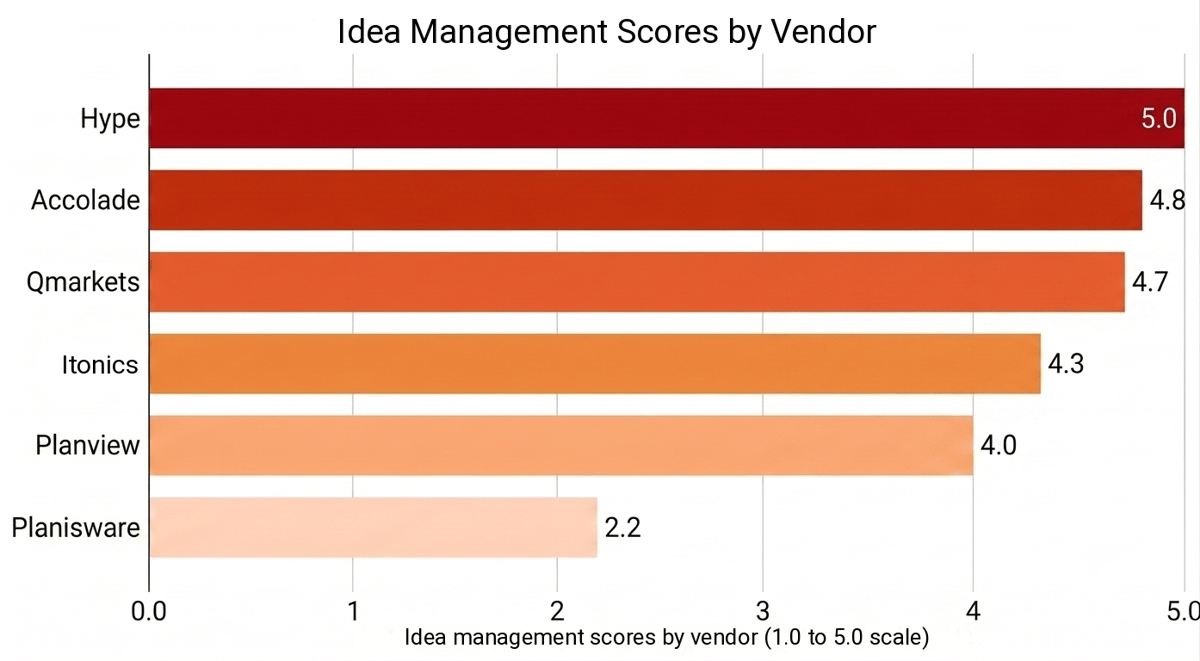
Idea Management Scores by Vendor
As an idea management tool, Hype scored a 5 in all six vectors we examined. Accolade and Qmarkets came in second and third, respectively, by a fraction of a point. All three got top marks in this category, showing sophistication in their handling of idea campaigns.
Opportunity Identification
“How well does the EIM system enable innovation workers to identify new FEI opportunities?”
Enterprises are always on the hunt to discover and evaluate new FEI opportunities. Instead of relying entirely on manual research, an EIM system should help keep an eye on external opportunities and leverage institutional memory.
There is a wide spectrum of EIM system performance in this area. Some players offer no dedicated technology scouting capabilities, while others allow for manually uploading or scanning scouting reports. At the highest level, AI agents scan for opportunities based on inferences from IM data.
When it comes to technology scouting process design, some systems offer no tools for designing the tech scouting process. Others include set or customizable templates. You can also look for platforms that offer tech scouting process reports to help managers track progress and outcomes, and role-based process design permissions so you know only qualified employees can alter how scouting is conducted.
Effective knowledge repository management relies on a system with automatic archiving, deep searchability, and intelligent redundancy prevention. Ideally, historical FEI projects get added to a fully searchable, filterable database, preserving the institutional memory across teams and business units. The most efficient platforms maintain a directory of their subject matter experts, making it easier to identify and connect with the right people when necessary. Advanced systems may also use AI agents to analyze incoming proposals against this archived data to surface relevant opportunities and prevent duplicate work.
When it comes to managing your knowledge repository, you need to know whether past FEI projects are automatically archived and, if so, whether those archives are searchable and filterable.
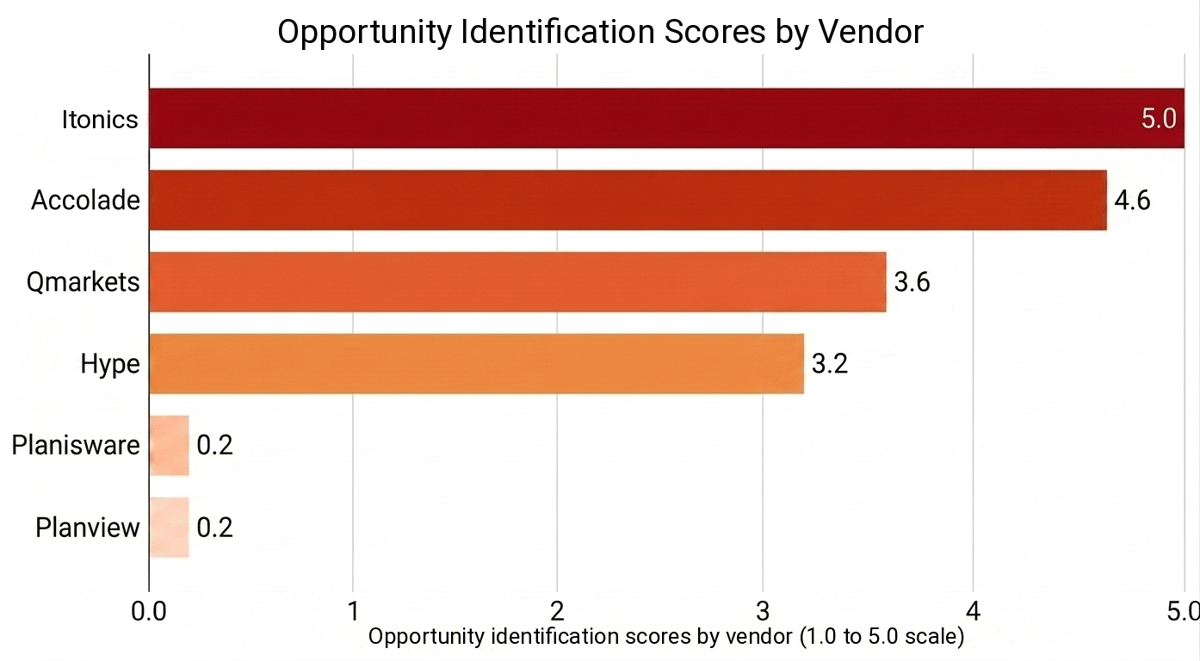
Opportunity Identification Scores by Vendor
Itonics comes in on top here with a perfect 5. Across all three vectors in this capability, Itonics’ platform demonstrates a commitment to assisting in tech scouting and identifying FEI opportunities.
Accolade also scores 5s in technology scouting and technology scouting process design.
The Next Steps in Choosing an EIM Solution
We’ve covered the baseline business outcomes and software capabilities that enterprises need from an innovation management system. But your choice of EIM needs to be driven by your own organization’s needs.
Here’s what you can do next.
Define Your Business Requirements and Technical Requirements
Selecting an EIM system without a strong idea of your capability gaps is a recipe for ending up with a tool that doesn’t really work for your organization. To evaluate EIM platforms effectively, enterprise leaders need clear expectations for how an EIM tool will facilitate and enhance their core competencies.
This can be accomplished by going through the seven business competencies and asking, “What do we need an EIM solution to do for us in this area?”
Focus your assessment on a couple of critical dimensions:
- Identify functional and cross-functional gaps
Go through each competency and identify current execution gaps. Where do processes struggle, or where does information fall through the cracks? Additionally, identify the friction points between these competencies. For instance, is there a gap between strategic planning and portfolio orchestration? - Define outcome improvements
Clarify how you would expect each competency to improve with the right EIM system in place. Would you expect to increase profit predictability in financial planning? Or would you hope to get a clearer understanding of your resource availability? Identifying your expectations will be key when you begin talking with vendors.
Once you assess your enterprise against the core business competencies, walk through each software capability above and ask yourself, “What does an EIM solution need to deliver technically to make this work?” Clarifying the outcomes you want to achieve reveals the technical standards the resource needs to meet.
Assess Your Growth Innovation Maturity
As we said at the outset, an EIM solution shouldn’t just improve efficiency; it should enable growth. But the potential returns aren’t just dependent on the tool. They come down to your enterprise’s ability to use the tool to optimize your innovation portfolio. That’s a question of your own innovation management maturity.
That means a key part of choosing an innovation management system that actually helps your enterprise grow tomorrow is understanding how prepared your enterprise is for growth innovation today.
Fortunately, we’ve created an exercise to help you with this! Our growth innovation maturity assessment evaluates your operational readiness across six critical areas, providing a benchmark for your current processes, so you can identify the gaps that an EIM tool can help you address. By taking this inventory, you’ll be better prepared to choose a platform that fits where you are while leaving room to scale.
Take the growth innovation maturity assessment right now.
Narrow Down Your Shortlist
Once you’ve mapped the outcomes you expect to achieve from an EIM solution and the necessary technical requirements, and assessed your growth innovation maturity, you’ll be ready to deep-dive into specific solutions.
This buyer’s guide and our companion EIM rankings list will help you narrow your search down so you can begin talking to the vendors best suited to your organization’s goals.
Get a Demo of Accolade
If you’re ready to see how a dedicated EIM platform can drive growth for your enterprise, reach out to us for a personalized demo of Accolade.
Frequently Asked Questions
What is an enterprise innovation management (EIM) system?
An EIM system is software that manages a global enterprise’s full innovation pipeline in one place. It links strategic planning, resource planning, budgets, governance, project execution, and idea management. That lets leaders see every initiative, keep projects aligned with growth goals, and make portfolio decisions from real-time data.
How is EIM software different from project management or ERP tools?
Project management tools and ERP modules track what has happened and schedule what needs to be done. EIM software also ties each project to the strategy and revenue goals behind it. It maps dependencies across the portfolio and enforces governance at each gate, so leaders can see how one change affects the rest of the pipeline.
What capabilities should an EIM system have?
This guide evaluates 16 capabilities. They include enterprise configurability, reporting, roadmapping, scenario modeling, revenue stream planning, resource planning, risk management, decision-making tools, idea management, and opportunity identification. Enterprise configurability matters most because it affects every business competency. A rigid tool forces teams to change how they work to fit the software.
Which EIM vendor scored highest overall?
Accolade scored highest at 4.3 out of 5, followed by Planisware (3.2), Planview (3.0), Itonics (2.7), Hype (2.5), and Qmarkets (2.2). Accolade led in strategic planning, portfolio orchestration, governance, and front-end innovation. Wellspring, which makes Accolade, conducted this evaluation, and the full scoring methodology is published in the appendix.
Which EIM platform is best for resource planning?
Planisware scored highest in resource planning at 4.4, followed by Planview at 4.2. Both earned perfect 5s in resource requisitioning and in resource utilization and cost tracking. Both also scored 4.6 in strategic resource planning, which makes either one a strong choice for capacity-heavy portfolios.
Which EIM platform is best for idea management and front-end innovation?
Hype earned a perfect 5 in idea management, and Itonics earned a perfect 5 in opportunity identification. Accolade earned the highest overall front-end innovation score at 4.6 because it ties ideas to growth objectives, financial planning, and downstream execution.
How were the EIM vendors scored?
Wellspring graded each vendor on 70 vectors, scored 0 to 5. The grades drew on user conversations, former vendor employees, implementation consultants, and online research. The vectors were weighted into 16 solution capabilities, which were weighted into seven business competency scores. A weighted average of those competencies produced each vendor’s final score.
What should an EIM RFP focus on?
An EIM RFP should focus on outcomes, not feature lists. Define the results you need in your workflows, data access, and governance, such as giving the executive committee cross-departmental data for resource decisions. Then ask vendors to show how their platform delivers those outcomes.
How long does it take to implement an EIM system?
EIM implementation takes a significant time investment. Teams need to configure the platform to their own operations, integrate it with existing systems, migrate project data, retire outdated tools, and train users. Be wary of any vendor that promises a fast, effortless rollout.
How do I choose the right EIM system for my organization?
Start by defining your business and technical requirements against the seven business competencies. Then assess your growth innovation maturity to see how ready your organization is to use the tool for growth. Use those findings to narrow your shortlist, then request demos from the vendors that best fit your goals.
Appendix: Enterprise Innovation Management System Scoring Methodology
In the spring of 2026, Wellspring Worldwide designed a rubric to evaluate the major enterprise innovation management systems on the market. This rubric graded tools on 70 individual vectors, assigning grades on a scale of 0–5. These vectors are the “hard” grades that describe exactly what a tool can do, and they’re informed by conversations with users, former vendor employees, EIM implementation consultants, and online research.
We grouped these 70 vectors into 16 solution capabilities, weighting the vector scores by how vital they are to supporting an overall solution capability. Solution capabilities are meant to address the common features buyers see when researching innovation management systems: “reporting,” “scenario modeling,” “roadmapping,” etc.
Solution capabilities exist to enable business competencies, so we mapped these solution capabilities to seven innovation management competencies and weighted them by importance.
For the sake of simplicity, we took a weighted average of business competency scores to produce a single final score for every EIM.
Final EIM Score Weights Explained
The final EIM scores for all six vendors are a weighted average of each vendor’s scores across seven business competencies. Business competencies were selected based on real-world expectations that arise in our interactions with innovation management system buyers at global enterprises.
|
EIM Score Weights |
|
|
Business Competency |
Weight in Final EIM Score |
|
Strategic planning |
15% |
|
Resource planning |
15% |
|
FP&A |
10% |
|
Portfolio orchestration |
25% |
|
Innovation governance |
15% |
|
Project management |
10% |
|
FEI |
10% |
Business Competency Score Weights Explained
Business competency scores represent how capable an EIM is at enabling certain innovation management activities. Each business competency score is a weighted average of relevant solution capability scores.
Note: Business competencies are not mutually exclusive. For example, “reporting” (a solution capability) factors into all seven business competency scores, as innovation managers depend on reports for all of them. However, the weights are different: reporting accounts for 30% of a vendor’s score in financial planning & analysis, but only 5% of its score in front-end innovation.
|
Business Competency Score Weighting |
|||||||
|
Solution Capability |
Business Competencies and Weights |
||||||
|
Strategic planning |
Resource planning |
Financial planning & analysis |
Portfolio orchestration |
Innovation governance |
Project management |
Front-end innovation |
|
|
Reporting |
10% |
10% |
30% |
5% |
20% |
10% |
5% |
|
Enterprise configurability |
10% |
15% |
10% |
30% |
25% |
30% |
20% |
|
Roadmapping |
20% |
0% |
0% |
25% |
0% |
10% |
0% |
|
Scenario modeling |
35% |
0% |
10% |
25% |
0% |
0% |
0% |
|
Document & deliverable management |
5% |
0% |
30% |
0% |
10% |
0% |
0% |
|
Revenue stream planning |
20% |
0% |
0% |
0% |
0% |
0% |
0% |
|
Resource requisitioning |
0% |
10% |
0% |
0% |
0% |
0% |
0% |
|
Strategic resource planning |
0% |
50% |
0% |
0% |
0% |
0% |
0% |
|
Resource utilization |
0% |
15% |
0% |
0% |
0% |
0% |
0% |
|
Financial planning |
0% |
0% |
10% |
5% |
0% |
10% |
0% |
|
Risk management |
0% |
0% |
10% |
10% |
15% |
0% |
0% |
|
Decision-making tools |
0% |
0% |
0% |
0% |
30% |
0% |
0% |
|
Project design |
0% |
0% |
0% |
0% |
0% |
20% |
0% |
|
Collaboration tools |
0% |
0% |
0% |
0% |
0% |
20% |
0% |
|
Idea management |
0% |
0% |
0% |
0% |
0% |
0% |
50% |
|
Opportunity identification |
0% |
0% |
0% |
0% |
0% |
0% |
25% |
Solution Capability Score Weights Explained
These solution capabilities are weighted groupings of 0–5 scores on 70 different grading vectors. The individual vectors and groupings are laid out below.
|
EIM Solution Capability Score Vectors and Weights |
||
|
Solution Capability |
Grading Vector |
Vector Weight |
|
Reporting |
Self-service reporting |
20% |
|
Real-time dashboards |
20% |
|
|
Custom reporting capabilities |
10% |
|
|
Technical skill required |
10% |
|
|
Data visualization |
10% |
|
|
AI report configuration |
10% |
|
|
AI reporting assistance |
10% |
|
|
Report portability |
10% |
|
|
Enterprise configurability |
Data relationship management capabilities |
25% |
|
Ease of data relationship management |
20% |
|
|
Metrics & calculation |
20% |
|
|
Data categorization |
10% |
|
|
Permissions & access configuration |
10% |
|
|
Workflow configuration capabilities |
10% |
|
|
Ease of permissions management |
5% |
|
|
Roadmapping |
Roadmap visualization |
35% |
|
Roadmap integration capabilities |
35% |
|
|
Roadmapping ease of use |
20% |
|
|
Roadmap portability |
10% |
|
|
Scenario modeling |
Evaluation criteria |
25% |
|
Scenario generation |
20% |
|
|
Scenario comparison |
20% |
|
|
Scenario modeling ease of use |
15% |
|
|
Scenario visualization |
10% |
|
|
Scenario implementation |
5% |
|
|
Planned vs. actuals scenario tracking |
5% |
|
|
Document & deliverable management |
AI document awareness (i.e., the EIM AI’s ability to access, scan, cite, summarize, edit, and create documents) |
40% |
|
Document management (i.e., the EIM’s ability to interlink documents and projects, set permissions, and support version control) |
30% |
|
|
Office 365 integration maturity |
30% |
|
|
Revenue stream planning |
Revenue stream awareness (i.e., the EIM’s ability to recognize revenue streams as entities and structure revenue stream hierarchies) |
40% |
|
Innovation revenue stream design (i.e., the EIM’s ability to map projects and portfolios to revenue streams) |
40% |
|
|
Revenue stream management (i.e., the EIM’s ability to apply ERP revenue data to innovation management entities) |
20% |
|
|
Resource requisitioning |
Requisition request submissions |
40% |
|
Requisition request approvals |
40% |
|
|
Resource commitment automation |
20% |
|
|
Strategic resource planning |
Resource pooling |
20% |
|
Facilities & equipment pooling |
20% |
|
|
Resource availability visibility |
20% |
|
|
Capability rebalancing |
20% |
|
|
Resource demand modeling |
20% |
|
|
Resource utilization |
Utilization tracking |
70% |
|
Resource cost recording |
30% |
|
|
Financial planning |
Financial system integration maturity |
100% |
|
Risk management |
IM risk awareness |
30% |
|
Risk aggregation |
30% |
|
|
Risk scoring and escalation |
20% |
|
|
Risk register management |
20% |
|
|
Decision-making tools |
Decision process design |
40% |
|
Decision process design ease of use |
20% |
|
|
Decision submission |
10% |
|
|
Decision approvals |
10% |
|
|
Change monitoring |
10% |
|
|
AI decision assistance |
10% |
|
|
Project design |
Project integration |
50% |
|
Project setup ease of use |
30% |
|
|
Program modification ease of use |
20% |
|
|
Collaboration tools |
Project management role designations |
30% |
|
Project assignment |
30% |
|
|
Project management approvals |
20% |
|
|
In-tool communication |
10% |
|
|
Third-party collaboration tool integrations |
10% |
|
|
Idea management |
IM idea awareness |
20% |
|
Opportunity process management |
20% |
|
|
Idea campaign management |
20% |
|
|
Idea evaluation management |
20% |
|
|
FEI resource awareness |
10% |
|
|
Idea submission management |
10% |
|
|
Opportunity identification |
Technology scouting |
40% |
|
Technology scouting process design |
40% |
|
|
Knowledge repository management |
20% |
|