

Quick summary
Accolade is the best enterprise innovation management (EIM) software of 2026, earning an overall score of 4.3 out of 5 in our June 2026 evaluation of six leading platforms. We graded each platform on 70 functional areas and scored them across seven business competencies: strategic planning, resource planning, financial planning and analysis, portfolio orchestration, innovation governance, project management, and front-end innovation. Planisware (3.2) and Planview (3.0) round out the top three with strong portfolio, resource, and reporting capabilities. Itonics (2.7), Hype Innovation (2.5), and Qmarkets (2.2) excel at front-end tasks like tech scouting and idea management but fall short on downstream execution. Accolade leads because its hyperconfigurability lets enterprises connect every project to strategic growth objectives without custom code or professional services.
Sometimes a handyman needs a complete toolkit. Sure, you could get the nicest screwdriver on the market, but it won’t do much when the job also calls for drilling, sawing, ratcheting, measuring, and leveling. The all-inclusive kit is what gets the whole job done.
Innovation software works the same way. Enterprise innovation is inherently complex, spanning many disciplines and cost centers. From idea management to new product development, every facet of innovation has its own complexities and frictions.
A true enterprise innovation management (EIM) solution accomplishes two things:
- It reduces friction, bringing clarity and efficiency to every project, program, and portfolio across the innovation ecosystem.
- It creates a throughline that connects daily activity back to the corporate strategy.
If an EIM solution delivers on the first point but not the second, you may end up streamlining unhelpful activities. That’s why the best EIM platforms don’t make you choose between prioritizing daily execution or executive-level orchestration. These platforms manage each stage of innovation and ensure that your portfolio remains aligned with organizational objectives.
In June 2026, we evaluated today’s top EIM solutions against a rigorous, 70-vector rubric to see which software best delivered on these two promises.
What Counts as an EIM Platform?
Not every innovation tool has both the function and scale to serve as an enterprise innovation management system.
Function represents the core capabilities an innovation manager or head of R&D expects from an EIM platform. These include the features necessary to capture, evaluate, execute, and track innovation activities. It’s a checklist of tools that help a team manage its pipeline from ideation to launch.
Scale determines whether those functions can actually survive the realities of a global enterprise. Offering a necessary feature on paper doesn’t necessarily mean that it can handle the operational complexity of multiple geographic regions, business units, and product lines. An EIM system must deliver its core functions at a scale that brings order to a large-scale organization.
This combination of function and scale allows EIM platforms to enable seven core business competencies:
- Strategic planning
- Resource planning
- Financial planning and analysis
- Portfolio orchestration
- Innovation governance
- Project management
- Front-end innovation
To determine the best EIM system, we scored the six most prominent EIM solutions on these seven business competencies.
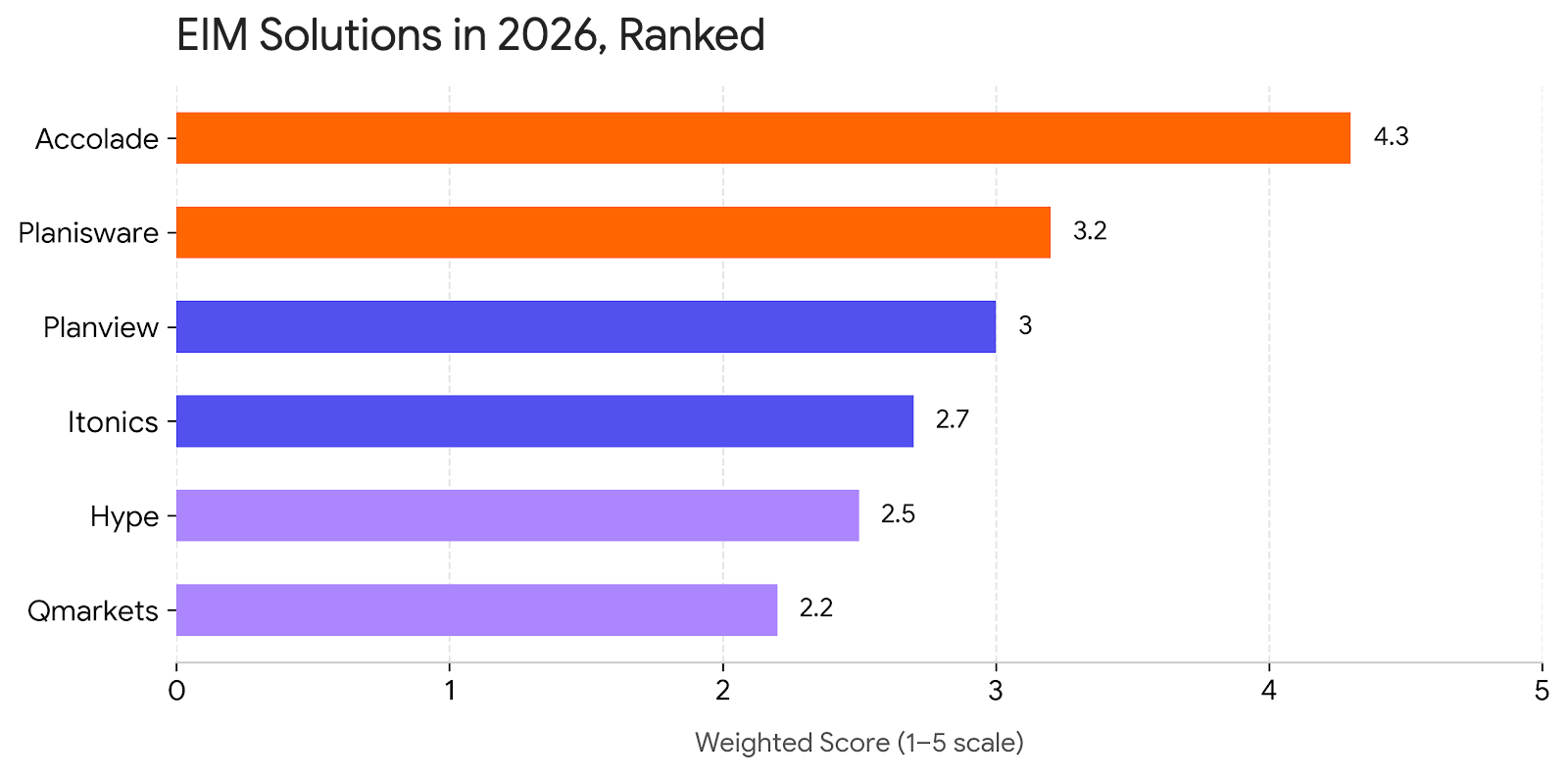
|
The Best EIM Solutions in 2026 |
|||
|
Rank |
EIM Solution |
Overall Score |
Summary |
|
1 |
Accolade |
4.3 |
Most configurable solution; handles complex innovation processes and portfolios |
|
2 |
Planisware |
3.2 |
Balanced SPM & PPM capabilities, best at resource planning |
|
3 |
Planview |
3 |
SPM-focused solution with robust decision-making tools |
|
4 |
Itonics |
2.7 |
Best technical scouting tools |
|
5 |
Hype Innovation |
2.5 |
Best idea management tools |
|
6 |
Qmarkets |
2.2 |
Primarily suited for managing FEI tasks |
How We Ranked the Top EIM Solutions
We graded each tool’s capabilities in 70 different functional areas, grouped in the following solution capabilities:
- Reporting
- Enterprise configurability
- Roadmapping
- Scenario modeling
- Documents & deliverables
- Revenue stream planning
- Resource requisitioning
- Strategic resource planning
- Resource utilization
- Financial planning
- Risk management
- Decision-making tools
- Project design
- Collaboration tools
- Idea management
- Opportunity identification
You can see a complete breakdown of our scoring methodology in “Choosing an Enterprise Innovation Management System.”
The Best EIM Systems Drive Growth
Enterprises look to innovation to fill revenue gaps and replace decaying revenue streams, not just accomplish assorted tasks. So you can’t simply compare the feature sets of various EIM solutions. You need to assess each solution’s ability to help enterprises drive legitimate growth.
As a result, we appraised the options through the lens of growth innovation, a philosophy that prioritizes growth as innovation’s most critical outcome. So as we looked at a vendor’s capabilities, we were also assessing how they contributed to the three growth innovation principles.
Growth
We reviewed how various platforms empower executives to drive organic growth by translating corporate objectives and revenue gaps into clear innovation targets. From there, we examined how they help ensure that every innovation activity is tied to filling those gaps and meeting those objectives.
Across every solution capability we examined, configurability emerged as a key force modifier. Without the ability to customize metrics and KPIs and use bespoke data tags and relationships, platforms make it more difficult to keep those projects aligned.
Visibility
We evaluated how well each platform provides stakeholders access to relevant information when they need it. An enterprise is always gathering data, and this intel needs to be available and reusable across the organization. EIM solutions must provide an exhaustive, searchable repository for past and present innovation data, robust and flexible reporting, and clear links between strategy, projects, risks, and resources.
We examined how platforms handle matrixed roles and permissions, ensuring global teams can freely collaborate while protecting sensitive data.
Configurability is an advantage here, too, allowing administrators to tailor dashboards, reporting automation, and data governance to everyone's exact visibility needs.
Orchestration
An EIM system should remove friction points throughout the innovation pipeline. This requires a robust orchestration layer that manages how ideas enter the pipeline, how they are evaluated, and how they advance. We also paid close attention to how platforms supported high-stakes decision-making and gave leadership the tools to prioritize, greenlight, and kill projects based on real-time data, ensuring projects stay aligned with objectives from conceptualization to launch.
When an EIM system is able to facilitate growth, visibility, and orchestration, it stops being a passive administration tool and becomes an active growth driver.
These Are Snapshot Scores From 2026
This is a good-faith attempt to assess each EIM platform. We interviewed users and former vendor employees and reviewed websites, marketing materials, and user ratings to accurately represent each platform’s strengths and weaknesses.
However, these vendors are updating their solutions all the time, and so are we. These scores reflect the best information we could gather during our study in June 2026. If you’ve used any of these tools recently (or if you’re employed by one of these vendors) and think some of these scores need a refresh, please reach out. We want to keep this overview as helpful as possible.
The 6 Best Enterprise Innovation Management Systems
Below, we’ll break down where each platform stacks up across key areas, focusing on the places where vendors demonstrate mastery across an entire business competency. For platforms with a more specialized footprint, we’ll zoom in on the specific features where they deliver distinct value.
1. Accolade
Overall score: 4.3 / 5
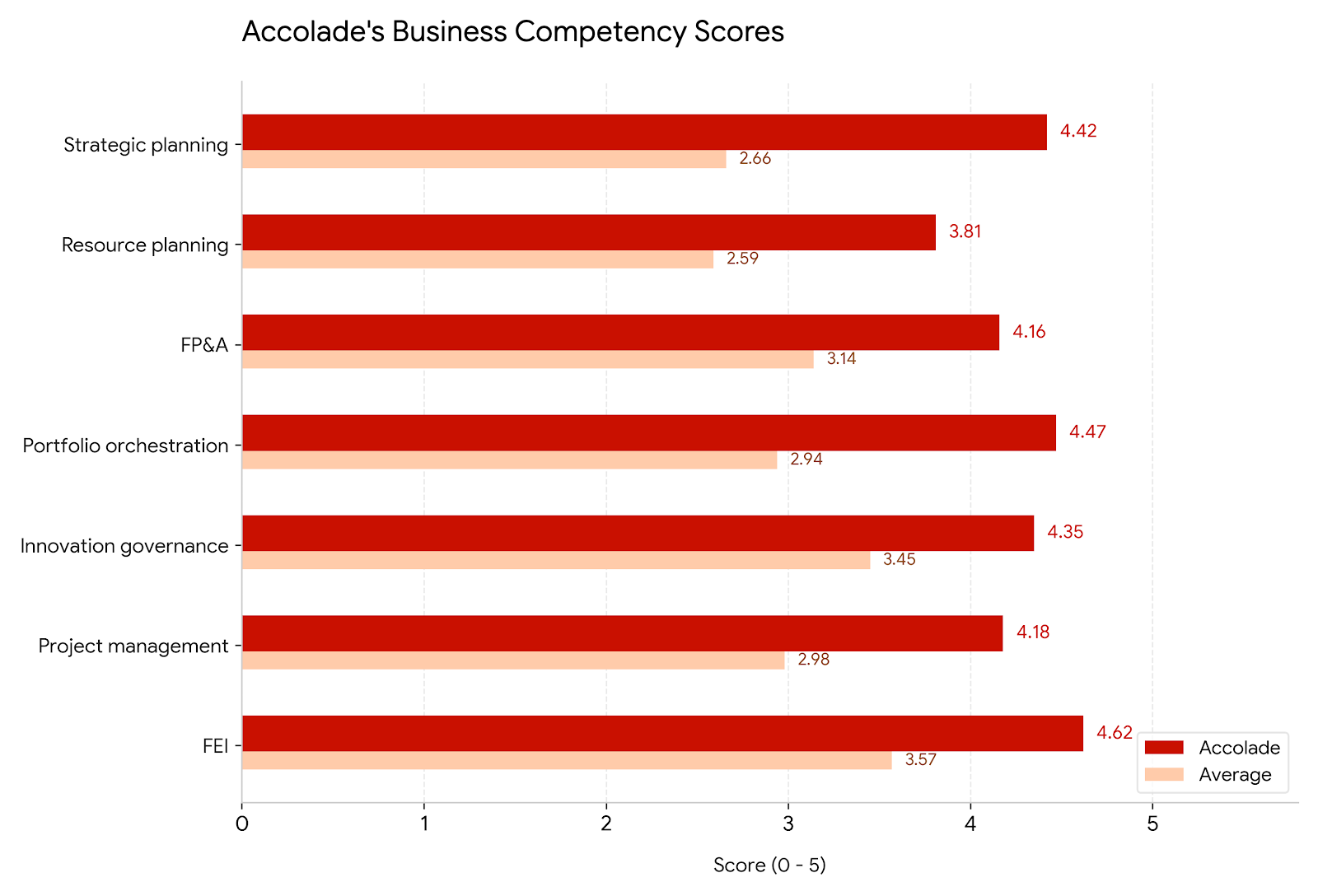
Unmatched Enterprise Configurability
Every platform offers some degree of configurability, but Accolade is hyperconfigurable. Accolade reflects your entire innovation ecosystem. Every workflow, every process, every metric, every data field, every dependency is bespoke to your organization. And this level of customization doesn’t require professional services, database expertise, or specialized coding skills. With some familiarity in IM tools, non-technical administrators can configure the platform to evolve alongside your innovation processes.
Purpose-Built for Growth Innovation
Executing tasks is table stakes for an EIM system, but innovation initiatives and projects only matter if they help the enterprise hit targets and mitigate revenue decay. Unfortunately, too many organizations struggle with the black box of innovation, where they pour time and resources into innovation without any clear visibility into the progress or outcomes of that investment.
Accolade’s hyperconfigurability allows leaders to collapse that black box by mapping every project to specific strategic objectives and then designing the custom governance protocols, metrics, reports, and dashboards necessary to monitor them. By replacing guesswork with tailored, data-driven oversight, enterprise teams gain the confidence to manage portfolios with certainty, ensuring every investment drives growth.
Strengths in Enabling Strategic Outcomes
Accolade integrates capabilities like revenue stream planning, risk modeling, and scenario modeling into a cohesive planning resource. In Accolade, leaders can test unlimited scenario iterations against complex real-world constraints, like shared lab facilities and specialized SME capacity, using bespoke risk metrics and financial guardrails to confidently assess trade-offs.
This strategic preparation carries over into portfolio orchestration with powerful roadmapping tools that track interdependencies across projects and portfolios. Composite roadmapping (building metaroadmaps of smaller roadmaps) allows PMs to filter every active initiative or project tied to a specific revenue gap or corporate objective. Through interconnected features like these, Accolade draws a clear throughline from top-level strategy down to every activity in the pipeline, giving leadership greater visibility and control over the portfolios they manage.
Strengths in Tactical Execution
EIM execution comes down to a platform’s ability to facilitate both idea and project management, while providing resilient governance safeguards. Accolade’s deep configurability helps it excel at all three.
When it comes to idea management, Accolade’s front-end innovation tools ensure that only validated concepts become early-stage inputs. Idea campaigns can be directly linked to strategic roadmaps, market research documents, or revenue targets, giving participants context on the problems they’re solving.
For project management, Accolade’s flexible architecture easily adapts to an enterprise’s real-world complexities and requirements. And once concepts move forward, Accolade’s flexible project design architecture enables management to craft tailored metrics and KPIs specific to bespoke project types.
Finally, Accolade protects the pipeline through a governance framework that maintains strict controls. Rule-based permissions and custom access levels enforce compliance and data security across departments. And because every active project remains linked back to interconnected resource pools, managers have the visibility necessary to safeguard prioritized projects and monitor capacity across portfolios.
The Bottom Line
Most EIM systems require enterprises to make a choice:
- Conform at least some of their processes, vernacular, and hierarchies to fit the system, or …
- Trust humans to play interpreter between the system and reality.
That’s not the case with Accolade. It molds to your enterprise, giving you a true digital representation of your innovation reality. This allows you to evaluate your entire innovation portfolio as a unified business case, ensuring your strategic decisions actually drive growth.
For global enterprises managing the complexity of multiple brands and diverse product lines, Accolade is clearly the right choice.
Interested in getting a hands-on look at what Accolade can do for your organization? Schedule a demo.
2. Planisware
Overall score: 3.2 / 5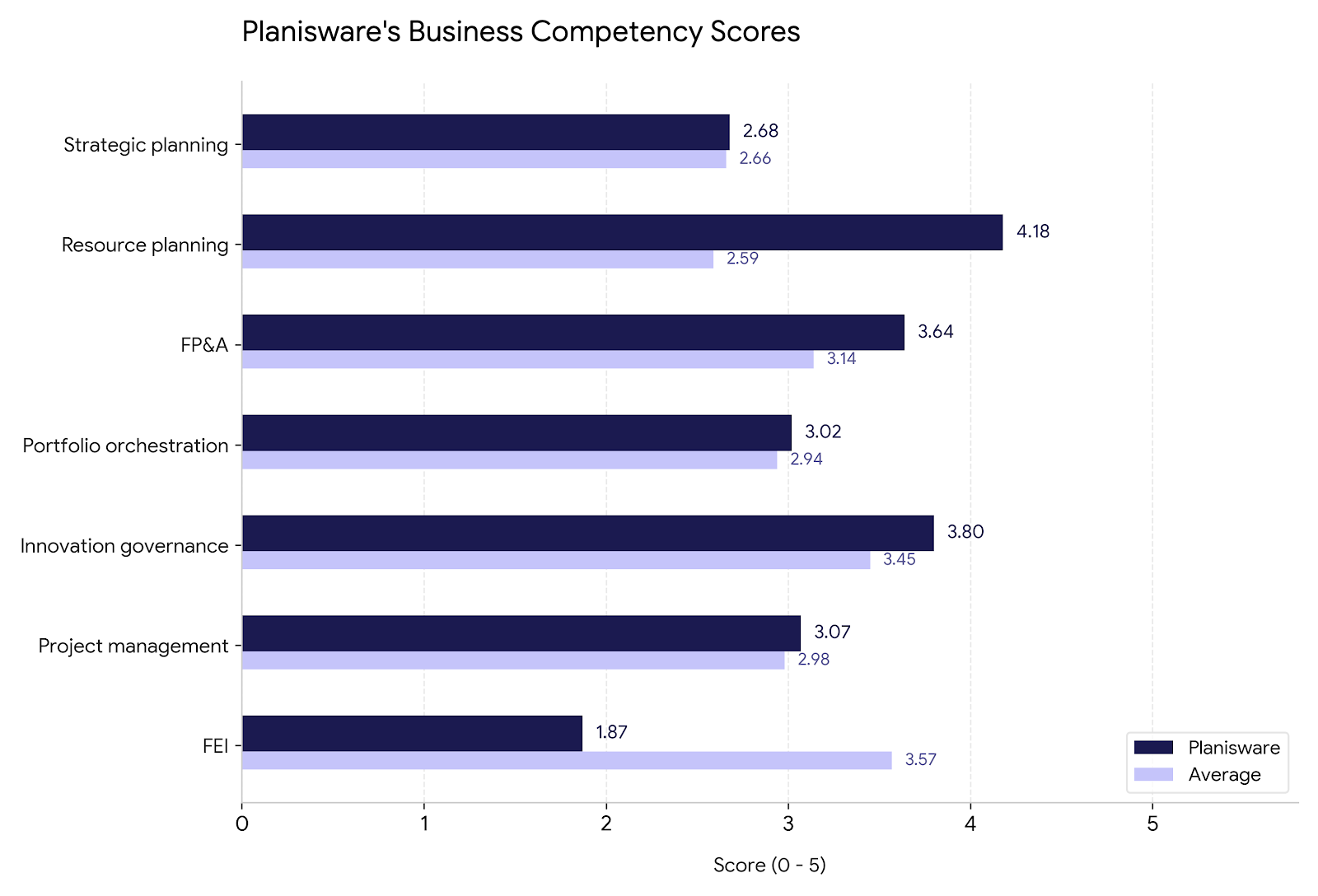
Planisware is a heavy-hitting PPM and SPM solution with above-average marks in enabling almost every innovation competency. Planisware is strong on reporting, risk management, decision-making, and in-tool collaboration, making it one of the top contenders for orchestrating expansive portfolios of projects and programs, and enforcing governance policies across them all.
Planisware has a distinctive advantage when it comes to resource planning and management. Human resources, shared facilities, and equipment are notoriously difficult to track, schedule, and allocate in innovation. But with Planisware, portfolio managers and R&D directors gain granular visibility into resource capacity, allowing them to use complex, bespoke availability and utilization measurements. Planisware eliminates resource blind spots, keeping pipelines moving without sudden bottlenecks.
The platform’s chief weakness is in front-end ideation, where it lacks many of the early-stage tools seen in other offerings.
The Bottom Line
Planisware’s execution capabilities make it a contender for organizations focused on keeping the innovation pipeline running smoothly. However, if you’re looking to crowdsource new ideas or scout for new tech partnerships, Planisware lacks key FEI-enabling functionality you’ll find in competing solutions like Accolade.
3. Planview
Overall score: 3 / 5
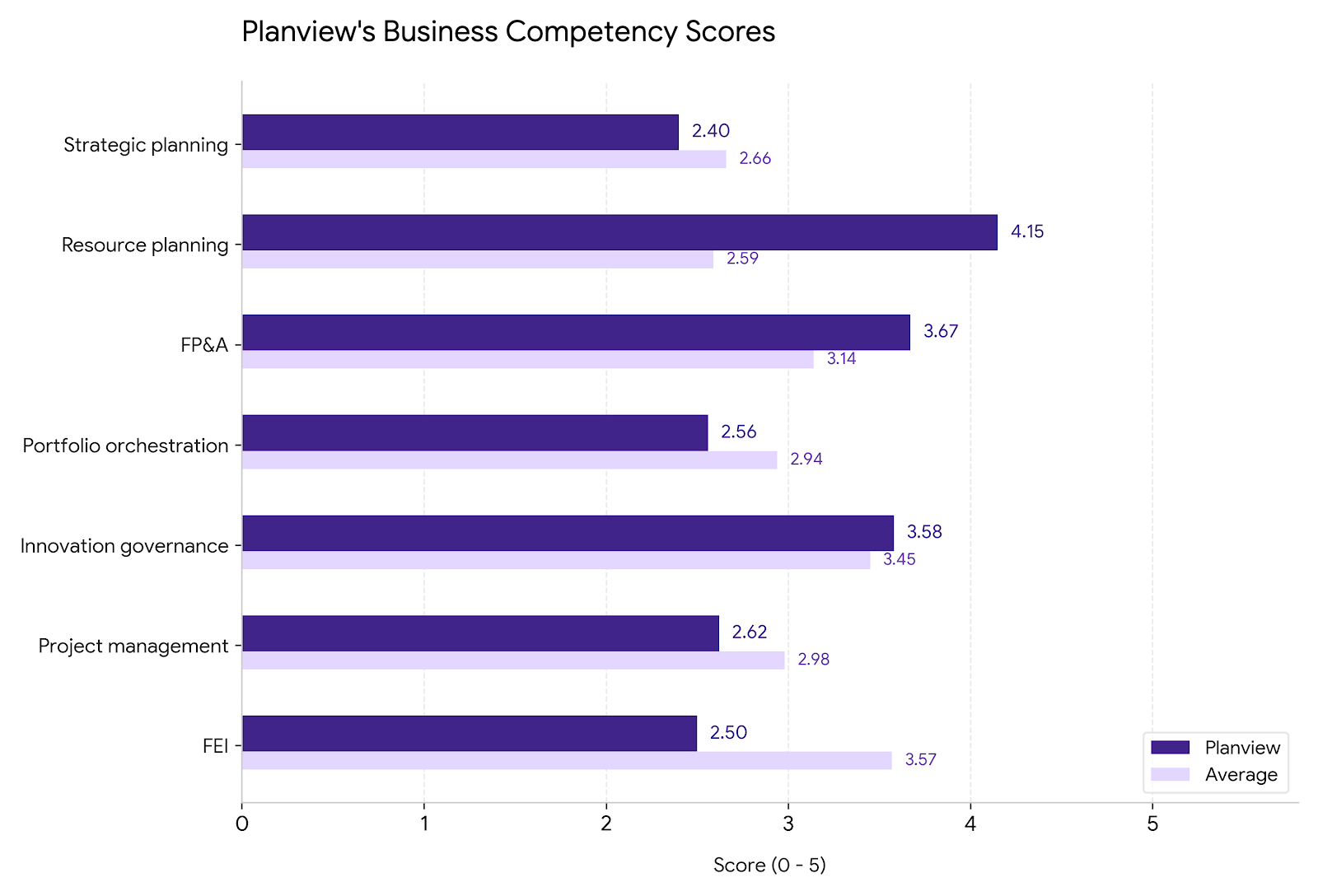
Planview rounds out the big three EIM system contenders because it’s an SPM heavyweight, specifically designed for organizations that need rigorous, high-level portfolio oversight. It edges out Accolade and Planisware in innovation reporting and decision-making tools. Paired with market-leading resource planning and above-average marks in FP&A and innovation governance, Planview provides leaders with exceptional financial tracking and budget compliance, as well as predictable resource allocation across complex project pipelines.
What keeps Planview from the number-two spot is its limited configurability. Planview provides impressive analytical and reporting capabilities, but it does so within a fairly rigid platform architecture. While it provides structured portfolio management tools right out of the box, organizations seeking to tailor their EIM platform to their unique operational structure will encounter legitimate snags.
The Bottom Line
Planview is no slouch as an enterprise-level SPM platform, outperforming Accolade and Planisware in both reporting and decision-making capabilities. The critical factor that causes Planview to lag behind both Accolade and Planisware is its lack of flexibility. While Planview remains a top-tier choice for managers seeking structured portfolio oversight, global enterprises may end up making their operations fit the system, instead of the other way around.
4. Itonics
Overall score: 2.7 / 5
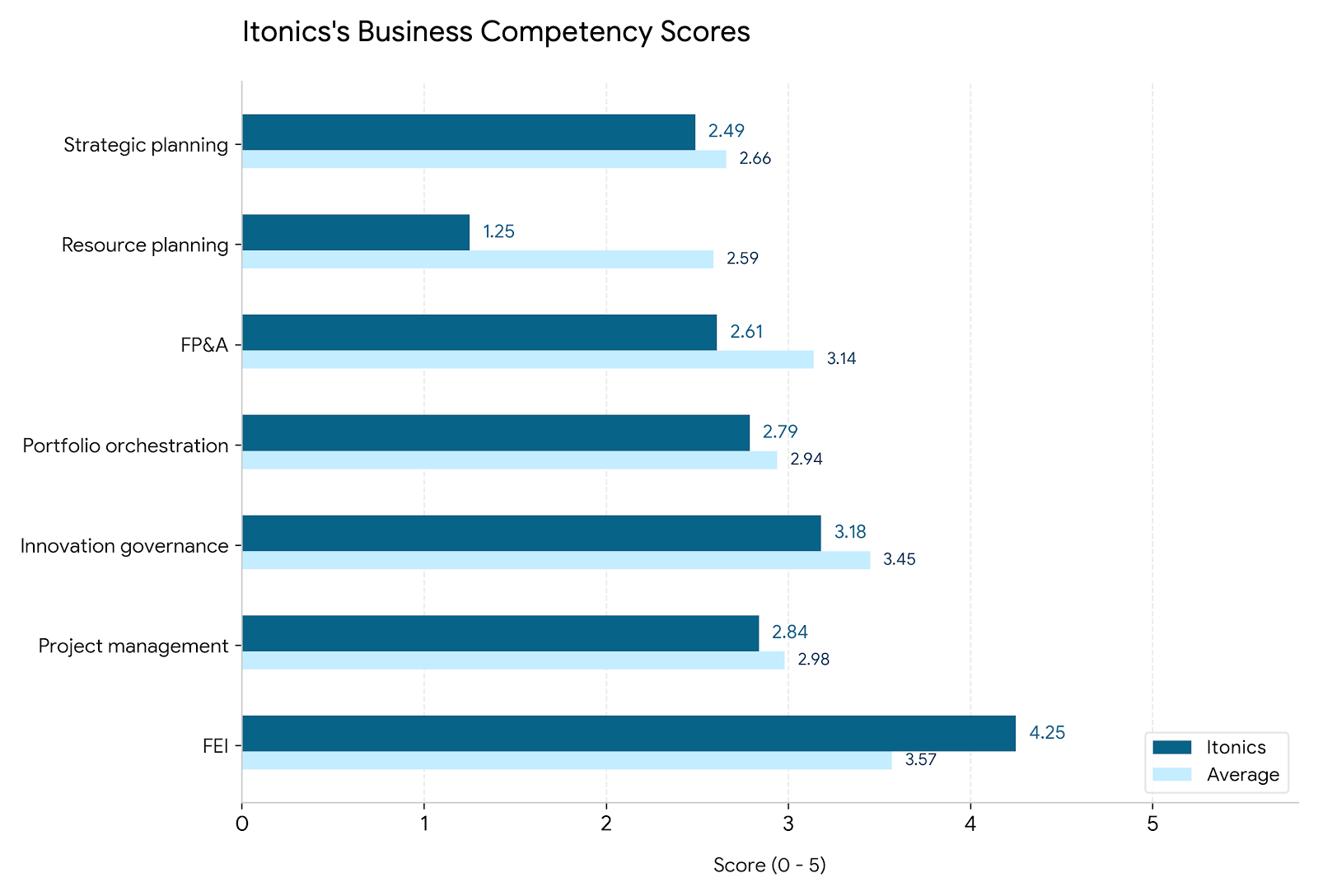
Itonics is a specialized achiever in front-end innovation, where it only trails Accolade. The driving force behind this score is Itonics’ tech scouting ability. It simplifies the tech scouting process, supporting ad hoc workflows, role-based permissions, and reports.
However, Itonics takes a sharp turn once projects transition from ideation to execution. Itonics scored below average in every downstream execution competency, most notably resource planning, where its score reflects a lack of strategic resource planning and asset management capabilities.
The Bottom Line
Itonics functions brilliantly as a radar for market intelligence and technological discovery, but struggles with downstream project delivery in complex enterprise environments. Unless you pair its front-end discovery engine with a system for project execution and resource management, you’ll feel Itonics’ limitations when using it as an EIM platform.
Hype Innovation
Overall score: 2.5/ 5
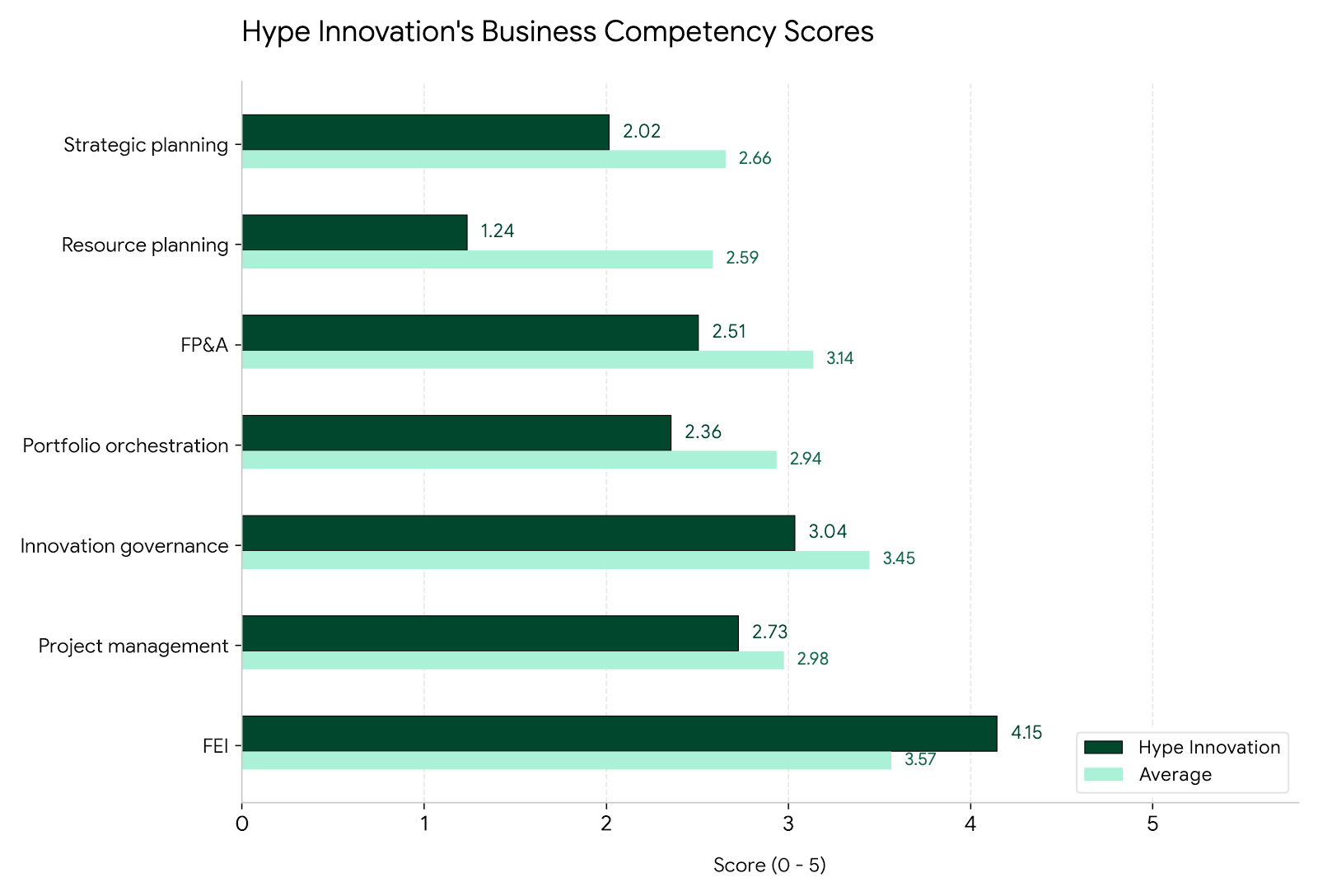
Hype Innovation is the only platform to earn a perfect score in idea management. Its focus on structured idea campaigns and gamified community engagement makes it arguably the most user-friendly ideation engine on the market.
Despite its front-end excellence, Hype Innovation should not be considered an end-to-end innovation management system. It scores below average across governance, project management, and portfolio orchestration, and demonstrates a critical deficiency in resource planning.
The Bottom Line
Hype Innovation is a potential solution if your main organizational challenge is crowdsourcing and evaluating raw ideas. But if you’re trying to upgrade your entire innovation ecosystem as well, Accolade is the better bet.
Qmarkets
Overall score: 2.2/ 5
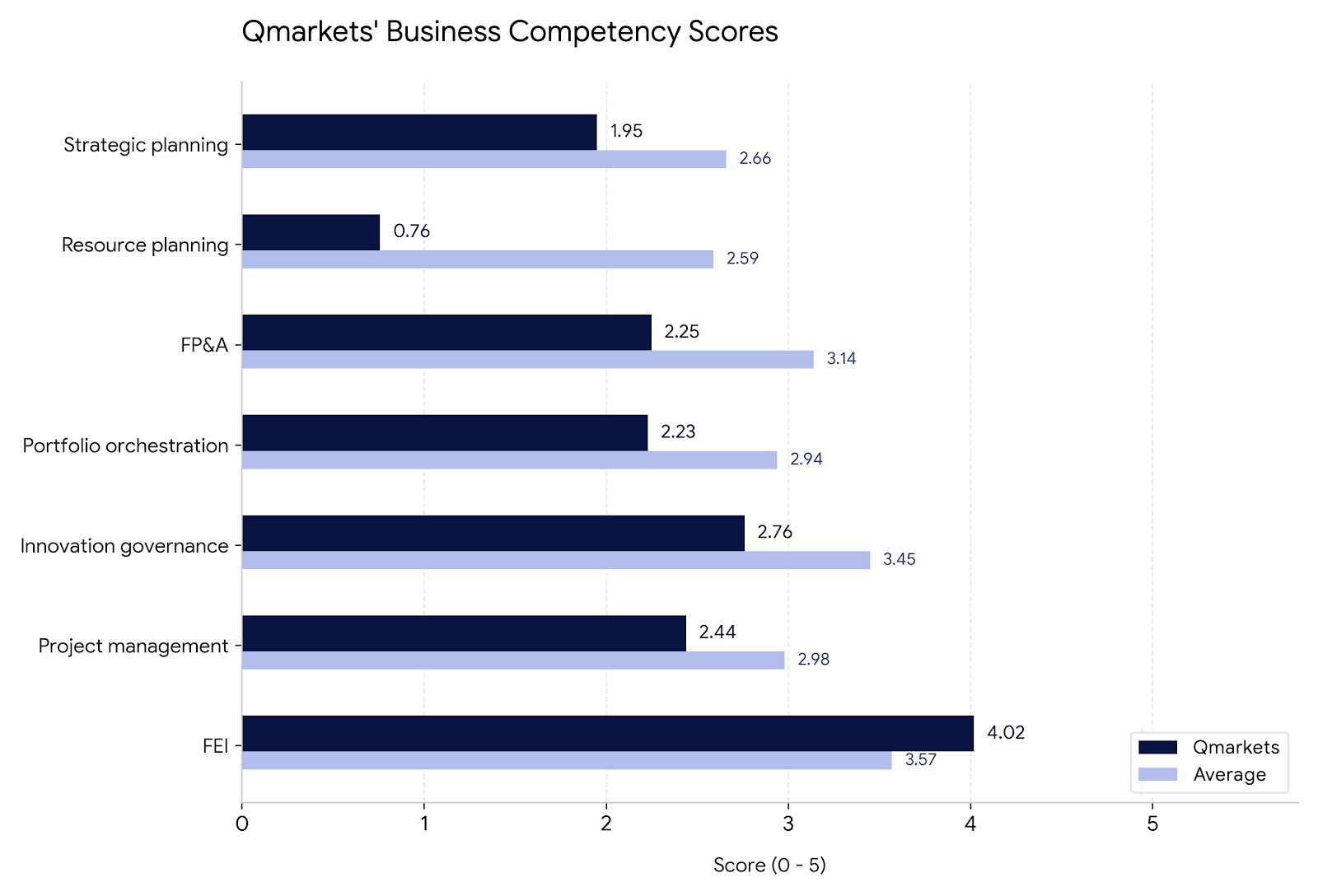
Qmarkets centers its value proposition on early-stage innovation, offering a hybrid toolkit designed to handle both internal ideation campaigns and external technical scouting. This split focus places the platform in a competitive middle ground. It delivers decent versatility across front-end intake, but it sacrifices specialization in any single area.
Compounding this front-end compromise is a total lack of downstream operational support. With scores that fall below average in every category, culminating in a disappointing 0.76 score in resource planning, Qmarkets offers negligible utility for leaders focused on innovation pipeline execution.
The Bottom Line
Qmarkets bridges the gap between ideation and tech scouting, which makes it a useful tool for the earliest stages of innovation. But it lacks necessary capabilities for pipeline execution and portfolio orchestration. This makes it more useful as a feeder system rather than a full-featured EIM platform. It remains a legitimate choice for teams seeking a generalist FEI portal, provided they rely on other IM tools to manage project delivery.
Choose an EIM Platform Built for Growth
An EIM system should function as a compound investment, delivering greater value with each cycle. As the platform continues to capture innovation data, it provides leadership with increasing clarity to allocate resources, kill lagging projects, and steer the portfolio toward the right targets.
If you’re still mapping out your requirements, check out “Choosing an Enterprise Innovation Management System.” It will offer objective, consistent evaluation criteria for choosing an EIM platform that fits your enterprise.
However, if you’re ready to see how the top-ranked platform can provide more visibility and drive more growth from your innovation ecosystem, schedule an Accolade demo today and discover how its hyperconfigurability and next-level functionality transform enterprise innovation.
Frequently Asked Questions
What is the best enterprise innovation management software in 2026?
Accolade ranked first with an overall score of 4.3 out of 5 in our June 2026 evaluation of six EIM platforms, followed by Planisware (3.2), Planview (3.0), Itonics (2.7), Hype Innovation (2.5), and Qmarkets (2.2). Accolade, Wellspring’s enterprise innovation management platform, earned the top spot for its hyperconfigurability, which lets enterprises tailor every workflow, metric, and data field to their organization and connect each project to strategic growth objectives.
What is an enterprise innovation management (EIM) system?
An enterprise innovation management system is software that manages the full innovation lifecycle, from ideation to launch, across a large organization. A true EIM platform combines function (the capabilities needed to capture, evaluate, execute, and track innovation activities) with scale (the ability to deliver those capabilities across multiple regions, business units, and product lines). It should reduce friction across every project, program, and portfolio while connecting daily activity back to corporate strategy.
How were the EIM platforms in this ranking evaluated?
Each platform was graded on 70 functional areas, grouped into 16 solution capabilities such as reporting, enterprise configurability, roadmapping, scenario modeling, resource utilization, and idea management. Those scores were then rolled up into seven business competencies: strategic planning, resource planning, financial planning and analysis, portfolio orchestration, innovation governance, project management, and front-end innovation. The evaluation drew on interviews with users and former vendor employees, along with reviews of vendor websites, marketing materials, and user ratings, and reflects information available in June 2026.
What should enterprises look for in an EIM platform?
Look for a platform that supports the three principles of growth innovation. Growth means translating corporate objectives and revenue gaps into innovation targets and tying every activity to them. Visibility means a searchable repository of innovation data, flexible reporting, and role-based permissions for global teams. Orchestration means managing how ideas enter, are evaluated, and advance through the pipeline, with tools to prioritize, greenlight, or kill projects based on real-time data. Configurability strengthens all three, because customizable metrics, KPIs, and data relationships keep projects aligned with strategy.
How do Planisware and Planview compare to Accolade?
Planisware (3.2) is a strong project portfolio management (PPM) and strategic portfolio management (SPM) solution with standout resource planning and above-average marks in nearly every competency, but it lacks many front-end ideation tools. Planview (3.0) is an SPM-focused platform that outperforms Accolade and Planisware in reporting and decision-making, but its rigid architecture limits configurability. Accolade (4.3) scored highest overall because it pairs strategic and tactical capabilities with deep configurability that doesn’t require coding or professional services.
Which EIM software is best for idea management?
Hype Innovation is the only platform in the evaluation to earn a perfect score in idea management, thanks to its structured idea campaigns and gamified community engagement. However, it scores below average in governance, project management, and portfolio orchestration and has a critical gap in resource planning, so it works best as an ideation tool rather than an end-to-end EIM system.
Which EIM software is best for technology scouting?
Itonics offers the strongest tech scouting tools in the evaluation, with support for ad hoc workflows, role-based permissions, and reports, and it trails only Accolade in front-end innovation overall. Qmarkets also combines internal ideation campaigns with external technical scouting. Both score below average in downstream execution competencies such as resource planning, so enterprises typically need to pair them with another system to manage project delivery.